Legal TechJanuary 26, 2026

What's New in Neos: February 2026

Oh it’s cold. Let’s just call it Febrrrruary! But snowstorms and sub-freezing temperatures can’t stop the Neos team from delivering some amazing new features! As always, don’t miss the “edutaining” (not a typo) New in Neos webinar on February 6 at 1pm, hosted by our VP of Education, Bryan Billig.

This is not all the features; it's just a selection of the most impactful. Read the full release.

Here’s the great new functionality coming to Neos the night of February 4.

New Features
Enhancements
New Features
Checklist Task Collaborators 

Keep entire teams aligned on shared checklist tasks with automatic reminders for everyone involved.

Requirements

  • Collaborators must be active staff members in the system.
  • Reminder delivery for each collaborator is controlled by their personal Checklist Reminders preference.

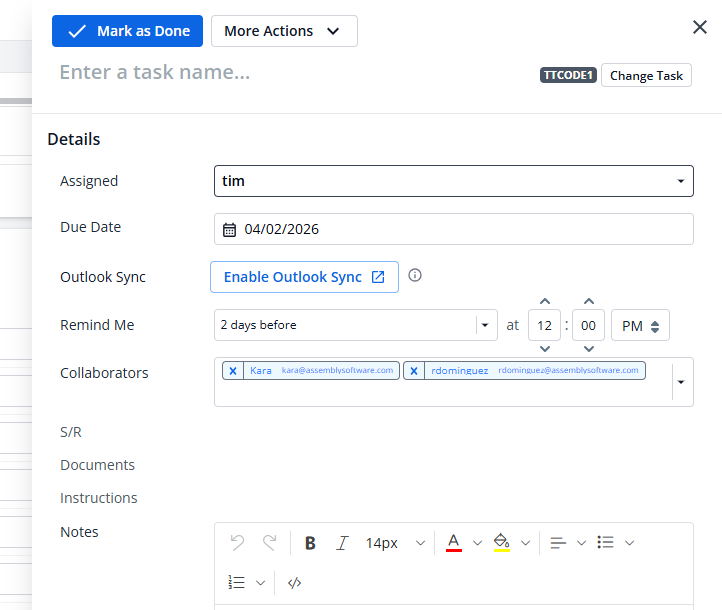
Collaborators Field

  • A new multi-select Collaborators field is available in the checklist task side pane.
  • Users can add one or more active staff members to any checklist task.
checklist-collab-release.png


Learn more about managing checklist collaborators in the Knowledge Base (click the question mark in the upper right-hand corner of Neos)

  • Coordinate shared responsibilities without manual status updates or check-ins
  • Ensure no one misses deadlines with automatic reminders sent to all collaborator
  • See which staff members are associated with specific tasks across your entire caseload

Add multiple team members as collaborators on any checklist task, so everyone stays informed without needing to be the assigned owner. Each collaborator receives automatic reminders based on their personal notification preferences. You can also search, filter, and bulk update collaborators across all your cases and intakes using Advanced Search and checklist grids.

Outlook Calendar Sync for Checklist Tasks 

Optionally sync important Neos checklist tasks to your Outlook calendar for on-the-go visibility with automatic updates from Neos to Outlook.

Refer to Knowledge Base or the full release notes to learn how to use this feature.


  • Keep the most important tasks and deadlines, like Statute of Limitation dates, top of mind across systems
  • Eliminate duplicate data entry with automatic updates that flow from Neos to Outlook

Never wonder whether a deadline is on your calendar again. The Outlook sync integration shows which checklist tasks are synced directly in your checklist grids, automatically updates Outlook events when task details change in Neos, and gives users full control over what syncs and when.

Global Search: Open Cases Only Filter 

Find what you need faster by filtering Global Search results to show only open cases.

NOTE: This filter is automatically applied. To remove, toggle the preference to OFF.

  • The Advanced Search button has been removed from Global Search to simplify the interface.
  • A new "Open Cases Only" toggle appears in Global Search for applicable search types.
  • After initial use, the system remembers your last toggle setting and applies it automatically in future sessions.
  • The toggle is active and functional for the following Global Search types: All, Case/Intake #, Alt Case #, Case Name, Case Title, Docket #, and Claim #.
  • For all other search types, the toggle appears greyed out with hover text explaining: "Filtering is limited to the following Global Search Types: All, Case/Intake #, Alt Case #, Case Name, Case Title, Docket #, and Claim #."
  • When the toggle is ON, search results display only open cases.
  • When the toggle is OFF, search results include both open and closed cases.


  • Easily find the case you're looking for by removing closed cases from everyday searches.

A new “Open Cases Only” toggle allows you to automatically hide closed case results when searching for cases. The toggle defaults to ON and remembers your last choice for future searches, so you don’t have to reset it each time.

Add Negation Operators to Advanced Search 

Filter out irrelevant data by excluding specific groups, collections, or criteria from your Advanced Search queries.

Requires the AdvancedSearchCollections module:

Users can now negate groups, collections, and list-type filters.
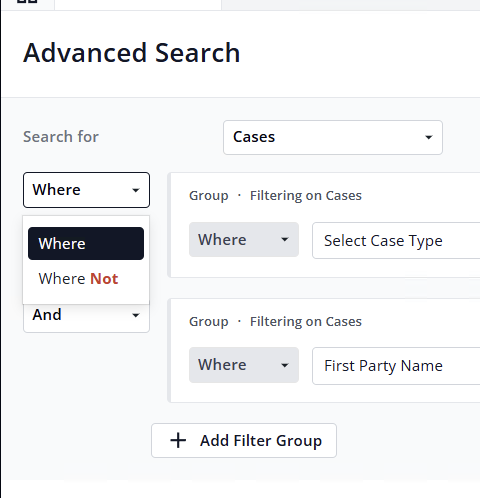
  • New conjunction operators available:
    • Where Not
    • And Not
    • Or Not
  • Negating a group or subgroup applies negation to each element within that group.
    • Example: If a group contains “Case Type = MVA AND Is Closed = False,” negating it returns results where the Case Type is not MVA or the case is Closed.
  • Negating a collection or list-type filter returns results where that collection item does not exist.
    • Example: If the filter is “Notes > Note Type = Email,” negating it returns cases that do not contain any email-type notes.
  • Double negatives are not allowed.
    • If a collection, subgroup, or filter is already negated and the user negates the top-level group, the inner negation automatically reverts to a standard conjunction.
negation-operators.png


  • Find relevant information faster by removing known irrelevant results from your searches
  • Build more powerful searches using exclusion logic. 
  • Reduce manual filtering by excluding unwanted data upfront

Advanced Search now supports negation operators, allowing you to explicitly define what should be excluded from your results. You can apply negation to entire groups, collections, or individual filters. This gives you precise control to eliminate noise and focus on exactly the data you need.

Add Subgroups of Conditions to Advanced Search  

Users can now create subgroups within Advanced Search groups and collections to build more complex, layered search conditions.

Navigate to Advanced Search > Add within a Group> Add Group.

  • A subgroup is added within the selected group.
  • Subgroups function the same way as top-level groups.
  • Allows for more complex queries with multiple layers of conditions.
  • Supports up to two subgroup levels.


  • Build more precise and sophisticated searches by nesting layered conditions.
  • Apply advanced grouping logic without running multiple separate searches.


Advanced Search now supports nested subgroups within groups and collections, allowing users to build multi-level search logic. Subgroups behave the same as top-level groups and support up to two levels of nesting, making it easier to construct complex queries.

Apply Multiple Conditions with Collection Groups in Advanced Search 

Users can now create collections within Advanced Search allowing multiple conditions to be applied to the same list (e.g., Notes or Value Items). This provides greater flexibility and precise search logic when building complex queries. 

Navigate to Advanced Search > + > Add Collection.

  • Select a collection (e.g., Notes, Value Items) and a field to filter by.
  • Add multiple conditions to the collection.
  • When the search is executed, all filters within the collection are evaluated together.
  • Within the collection, click + to add a sub-collection.
  • Supports up to two collection levels.
  • Example use cases:
    • Example A: Returns cases with at least one email-type note created in the last 30 days.
    • Example B: Returns cases with at least one email-type note and at least one note created in the last 30 days.
    • Example C: Returns cases with at least one value item coded as CASEEXP and a payment-type transaction of at least $10.
multiple-collections.png


Refer to the Knowledge Base for additional details.

  • Find exactly what you need by applying multi-layered conditions to the same underlying data set (such as notes or value items).
  • Save time by building sophisticated searches in a single query instead of running multiple separate searches.

Users can now create collection groups within Advanced Search, allowing multiple conditions to be applied to the same list (e.g., Notes, Value Items). This provides greater flexibility and precision when building complex search queries.

Enhancements
Reply to Emails and Pin Important Notes 

Respond to case-related emails directly in Neos and mark critical notes as important using a visible indicator.

Reply to Email from Neos

  • Navigate to the Notes tab or Activity Feed in a case or intake.
  • Locate an email note and select Reply, Reply All, or Forward.
  • Neos automatically pre-fills the email subject, body, and recipients.
  • Send the email, and Neos saves it as a new note in the case or intake.


Pin Notes in Case/Intake

  • In the Notes tab, mark a note as important by selecting the appropriate option.
  • The note displays a red exclamation mark and is highlighted in the notes grid.
  • If your firm has visibility settings enabled, important notes are pinned to the top of the notes list.
  • This feature is not available for text messages at this time.


  • Keep all case communication in one place without juggling multiple applications.
  • Ensure critical case notes remain visible through use of visual highlights and optional pinning to the top of the Notes list.

Stay in your workflow without switching between applications. You can now reply, reply all, or forward case- and intake-related emails directly from the Notes tab or Activity Feed. Neos automatically pre-fills the email details and saves your response as a new note.  Mark important notes with a visual indicator, and when enabled by firm settings, pin them to the top of your Notes list so urgent information stays visible.

image_(27).png


Full Markdown Formatting Across NeosAI Outputs (NeosAI Platinum users only)

NeosAI Chat, Case Summaries, and AI Document Generation now deliver professionally formatted outputs — including tables, headers, bold text, and lists — ready to use without manual cleanup.

NeosAI Case Summaries

  • Newly generated case summaries automatically render markdown formatting based on the AI response.
  • Existing case summaries must be refreshed or regenerated to display the updated formatting.
  • Supported formatting includes bold headers, bullet points, and tables.
  • When a case summary is emailed, the formatting is preserved in the email.


NeosAI Chat and NeosAI Document Generation
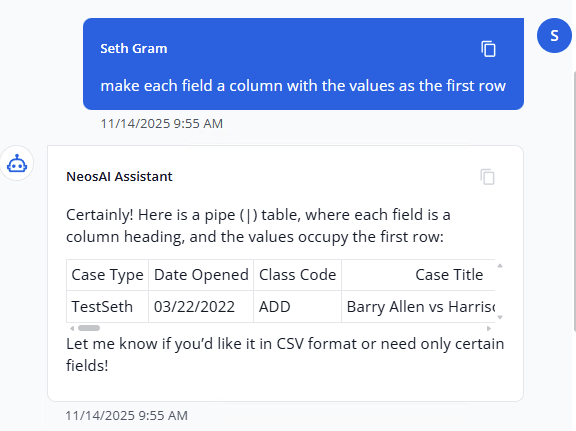
  • NeosAI Chat and NeosAI Document Generation automatically apply full styling and formatting to responses.
  • Supported formatting includes: tables, bolded headers, bulleted lists, numbered lists, etc.
  • Customize formatting: Specify desired formatting in the Chat prompt or Additional Instructions field (for AI Doc Gen) to control how NeosAI structures the output.
  • NeosAI Document Generation: Any formatting displayed in the preview pane will be preserved and applied within the generated Word document.
  • NeosAI Chat: Formatting displayed in the chat side pane is maintained when copied to clipboard or generated as a note.
AI_table.png


  • Find information faster with clear visual hierarchy and structured formatting
  • Save time by using AI outputs directly in client communications without reformatting

NeosAI now renders markdown-formatted responses with rich styling across Chat, Case Summaries, and AI Document Generation. Structured content such as tables, bulleted lists, and bold headers display automatically in the interface. No more copying plain text into another tool to add formatting; everything is ready to share. 

Register for the New in Neos webinar on February 6 at 1pm ET!

Hosted by the ebullient Bryan Billig, VP of Customer Education

Bryan will demo all the amazing new features being released this month in real time, cracking jokes along the way.

SHARE

Related to this article

new in neos feb

Legal Tech

Check out all the innovative new features and enhancements coming out with March's brand new release!

new in neos feb

Legal Tech

Check out all the innovative new features and enhancements coming out with February's brand new release!

excited man at laptop

Legal Tech

You asked, we delivered! Here’s a look at the top customer-requested enhancements we’ve rolled out in 2025 to date.

Schedule a Neos demo

Manage your daily operations in less time, so you can spend more time focusing on your clients. See how it's possible.