November 05, 2025

What's New in Neos: November 2025

As 2025 winds down, Neos is picking up speed! Our November release—deploying the night of November 12—wraps up the year with meaningful upgrades to AI, automations, and integrations that set you up for an even stronger 2026. Read the extended release version. 

Watch the “New in Neos” on-demand webinar at your leisure.

New Features
New Enhancements
Improvements and Updates
New Features
New Zapier Search Functions 

Two new Search steps are available in the Neos Zapier app:

  • Find Case or Intake by Number
  • Find Case or Intake by First Party

The Zapier search feature now checks for existing cases or intakes before creating new ones, allowing users to connect to records from other Zaps and preventing duplicate entries in your environment.

When building a Zap, add one of the new search steps and map the search field to your Case Number or First Party. The results can then be used in subsequent steps of your Zap workflow.

Important: These new search steps are available only in the latest version of the Neos Zapier app, released earlier this year.

  • Any existing Zaps built on an older version must be upgraded.
  • The current version has been marked as Deprecating and will be officially deprecated by the end of February 2026.
  • Be sure to upgrade your Zaps before that date.
New Enhancements
Expanded AI Medical Record Extraction Capabilities (NeosAI Platinum )

We’ve enhanced Medical Record Extractions to further reduce manual data entry and speed up case preparation.

  • Upload medical records and select Analyze with AI to extract medical data.
  • NeosAI automatically identifies and maps key details such as treatments, examinations, diagnoses, and medications.
  • Extracted data is organized into standardized Dynamic Layouts in chronological order, including titles, dates, providers, and AI-generated descriptions.

*The expanded AI Medical Record Extraction Capabilities were originally deployed to Production with a maintenance release on September 29, 2025.


It dramatically reduces the time and effort required to review and organize medical records.

  • Instead of manually reading through lengthy documents and entering details one by one, NeosAI automatically extracts and structures the information into a clear, chronological layout.
  • This ensures greater accuracy, consistency, and efficiency across cases—allowing teams to focus on analysis and case strategy rather than administrative data entry.
  • Navigate to Settings > Dynamic Layouts.
    • Default layouts for Examinations, Medication, Medical Condition, and Treatment now include:
      • Examination
      • Medication
      • Diagnosis
      • Treatment
      • Date
      • Provider
      • Description.
    • Users can reset these layouts to default if previously modified in the Dynamic Layout Editor.
  • The Medical Record Extraction type uses an LLM to populate fields as follows:
    • Examination/Medication/Diagnosis/Treatment: exact text extracted from the document.
      • Added two new fields to Examinations: Medical Provider and Examination Results.
    • Date: date of the examination, medication, or diagnosis as mentioned in the document.
    • Provider: name of the provider or “Unknown” if none is specified.
    • Description: brief summary describing the context based on document data.
  • Name fields will include any medical codes found that match the extracted text.
Added New AI Prompts and Tags (NeosAI Platinum)

We’ve added additional AI Prompts and Tags to NeosAI Platinum.

Expands the pre-configured list of prompts and tags to help firms generate more precise demand letters and case-specific outputs using document generation and chat.

  • Settings > AI Tags - the following tags were added:
    • CPT/Diagnostic Codes
    • Demand Introduction with Case Valuation
    • Demand Injuries
    • Demand Liability
    • Demand Lost Wages
    • Demand Offenses Charged
    • Demand Permanency
    • Demand Prognosis
    • Demand Specials
    • Demand Treatment
  • Settings > AI Prompts - the following prompts were added:
    • Projected Settlement: Summary
    • Projected Settlement: Value Drivers
    • Medical Crosswalk - 1. with Claim Validation
    • Medical Crosswalk - 2. Average Regional Charge Ranges
    • Deposition - Admitted Facts Finder
    • Deposition - Credibility Indicators
    • Deposition - Inconsistencies
    • Deposition - Issue Tags
    • Deposition - Liability Related Testimony
    • Deposition - Summary
Added Grouping to Medical Codes in Advanced Search 

Users can now group search results by medical code when working with Examinations, Medical Conditions, Medication, or Treatment in Advanced Search.

  • Enables users to easily analyze and summarize medical information by grouping related codes, improving the accuracy of data insights.
  • Simplifies reporting workflows by allowing teams to view and interpret medical data in structured, code-based groupings.
  • Advanced Search > Search for Examinations, Medical Conditions, Medications or Treatments > Add any Medical Code column(s) to the results grid > Open 3-dot menu for the Medical Code column > Group By This Column
    • Results will automatically be grouped by medical code
Automations 
  • This release introduces multiple enhancements to Neos Automations that improve usability, flexibility, and visibility across automation setup, execution, and tracking.
  • Updates include new triggers for case creation and closure, new options for email recipients, expanded search and filtering in automation history, and interface improvements for creating, managing, and reviewing automations.

Customer Requests #2471, 1903, 3224, 2747


These updates make automations more powerful and accessible to users across all roles.

ADDITIONAL TRIGGERS and ACTIONS UPDATES
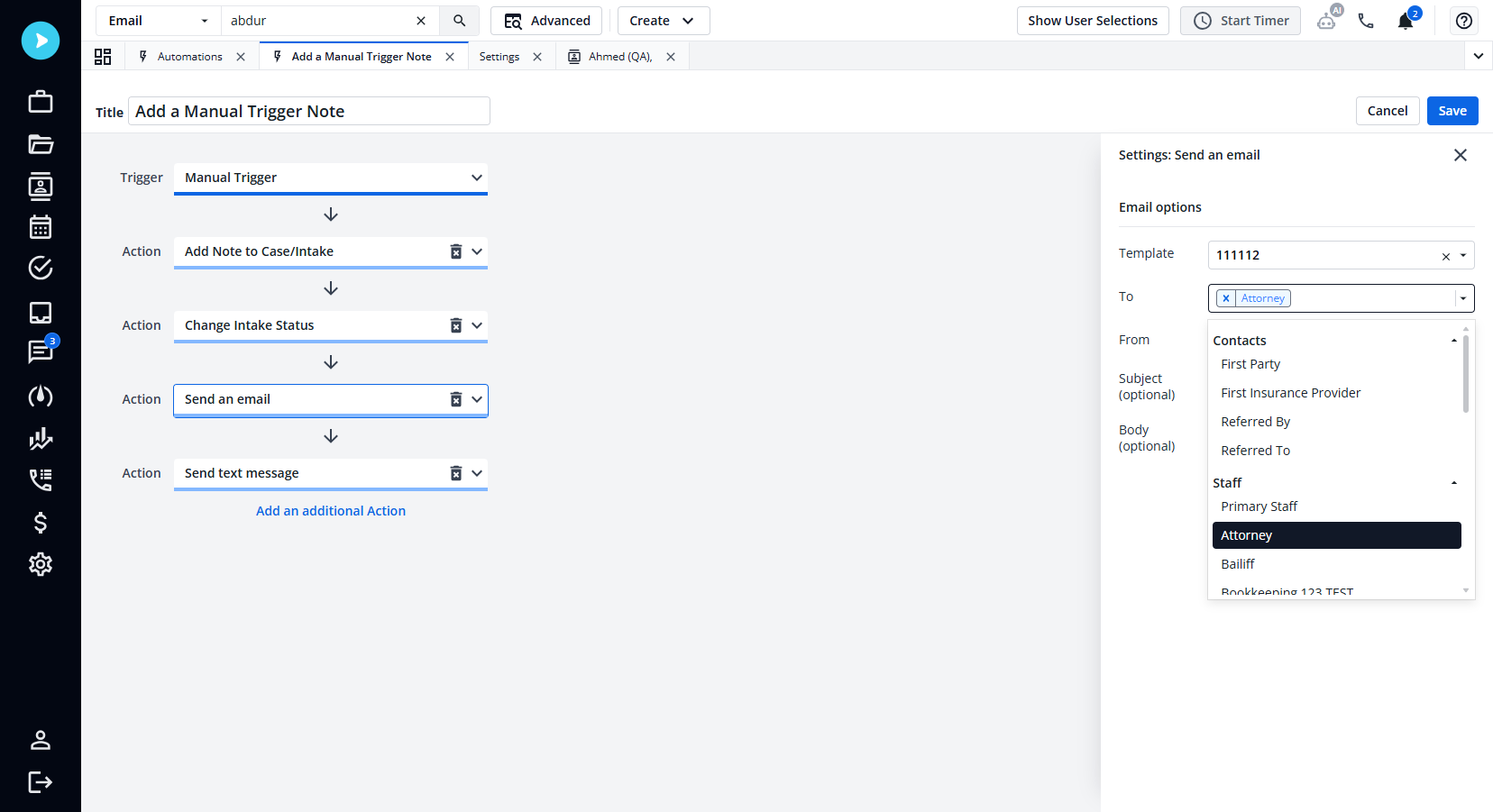
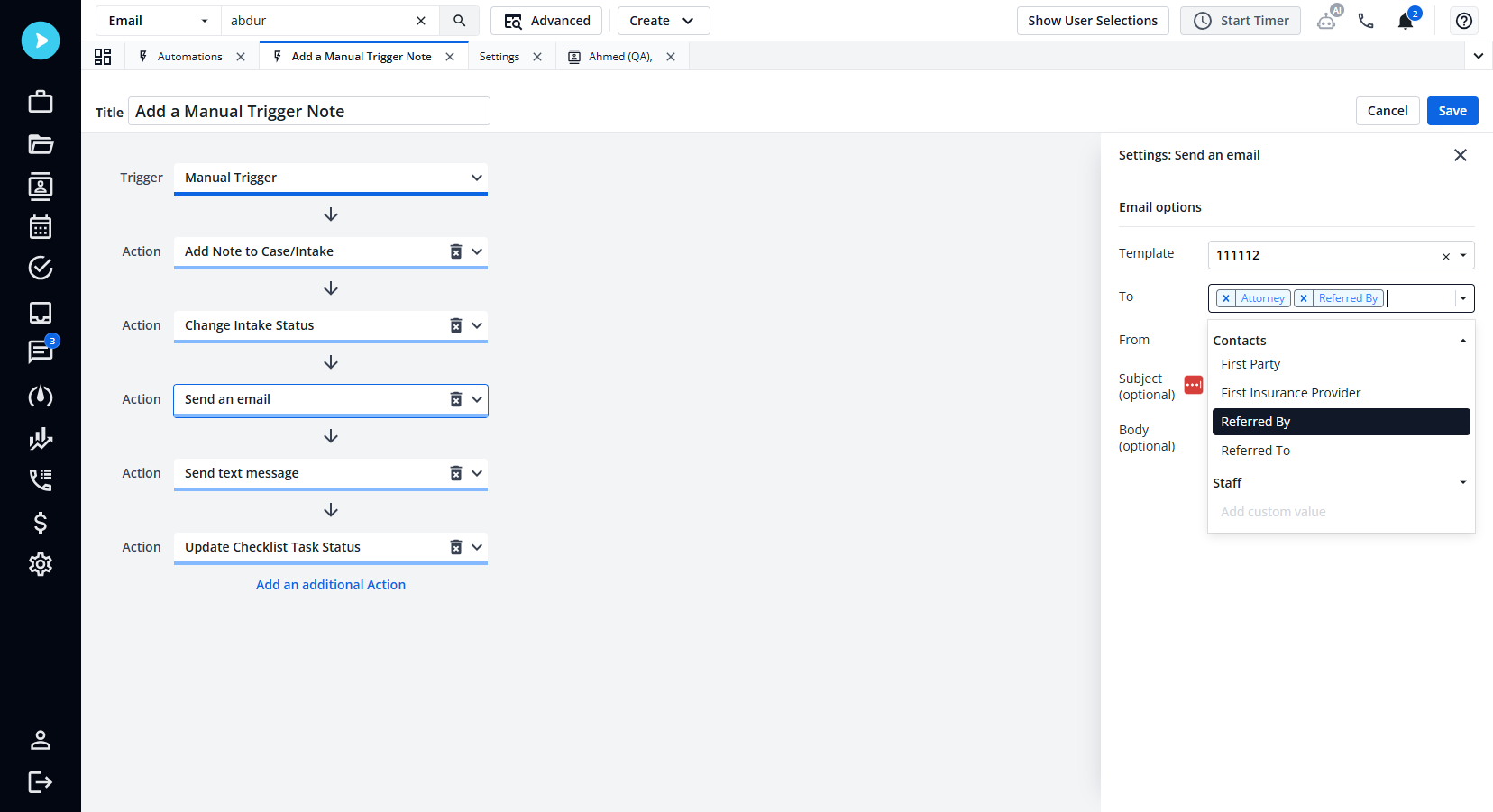
  • Add All Staff Roles to Email Action Recipient List
    • Users can now add any active staff role from the directory as a recipient in a “Send an Email” automation action.
    • The “To” dropdown is now multi-select and organized into two sections:
      • Contacts – Displays First Party, First Insurance, Referred By, and Referred To
      • Staff – Displays Primary Staff first, followed by all active staff roles across cases
    • If a staff member is assigned to a role within a case or intake and has an email address saved in their staff profile, they will automatically receive any emails sent to that role through an automation.
Add_All_Staff_Roles_to_Email_Action_Recipient_List_Image.png


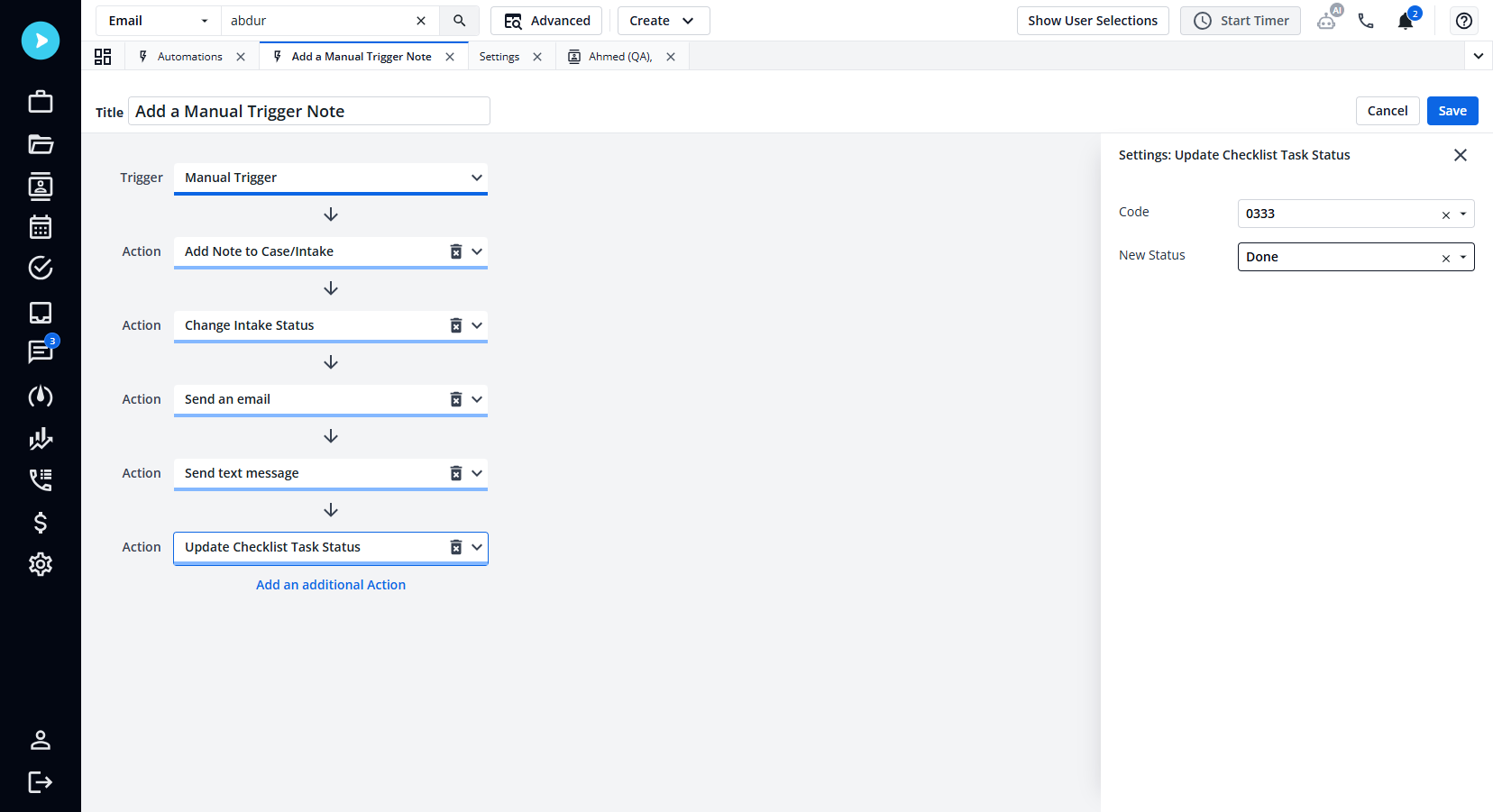
  • Action – Update Checklist Task Status
    • Users can now create an automation that updates a checklist task’s status as one of the available actions.
    • The action is called “Update Checklist Task Status.”
      • Settings
        • Checklist Code – Displays all existing checklist codes
        • Task Status – Select the new status to update the task to
      • Repeating Items
        • Repeating items with Auto-repeat unchecked that are closed through an automation will remain closed and will not automatically re-open.
        • Repeating items with Auto-repeat checked will re-open (as if the user selected “Yes” on the re-open prompt) with the updated due date.
    • Child tasks of parent tasks closed by an automation will continue to be added to the case as expected.
Action_–_Update_Checklist_Task_Status_Image.png


  • Add Referred By & Referred To Contacts to Email Recipient List
    • The Referred By and Referred To contact roles have been added to the "Contacts" subsection in the "Send an Email" action’s "To" dropdown.
    • When Referred By or Referred To is selected in the To dropdown within the email options, the primary email address of the contact assigned to the case or intake’s Referred By or Referred To field will automatically be added as a recipient for the outgoing email.
Add_Referred_By_&_Referred_To_Contacts_to_Email_Recipient_List_Image.png


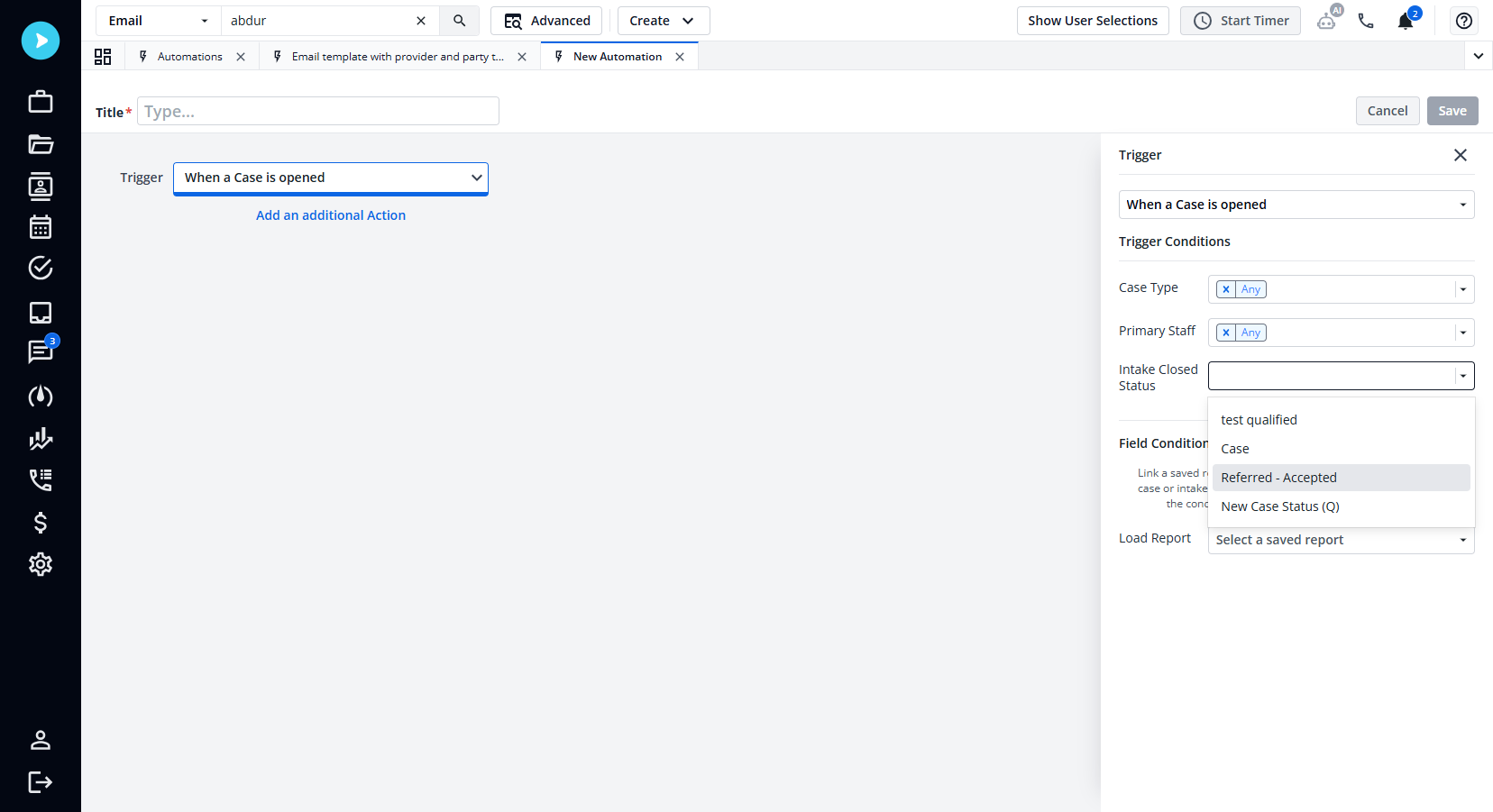
  • New Trigger - Case Opened
    • Users can now create automations that trigger when a case is created, either by converting an intake into a case or by creating and saving a new case directly.
    • A new trigger has been added called "When a Case is Opened."
      • Conditions:
        • Case Type – Defaults to "Any" (required, multi-select).
        • Primary Staff – Defaults to "Any" (includes Null Primary Staff), not required, multi-select, displays staff directory list.
        • Intake Closed Status – Not required, multi-select, displays all Closed-Staged, Qualified, and Active intake statuses (same options as the status dropdown in the "Make a Case" workflow).
      • Disabled Actions:
        • The "Change Intake Status" action is disabled for this trigger.
        • If the "Change Intake Status" action was already selected, it will be removed when switching to this trigger.
      • This trigger activates when:
        • An intake is converted into a case through the "Make a Case" workflow.
        • A new case is created through the + New Case workflow.
        • A case is created directly through the API from a third-party integration.
      • This trigger does not activate when cases are imported through the import workflow.
New_Trigger_-_Case_Opened_Image.png


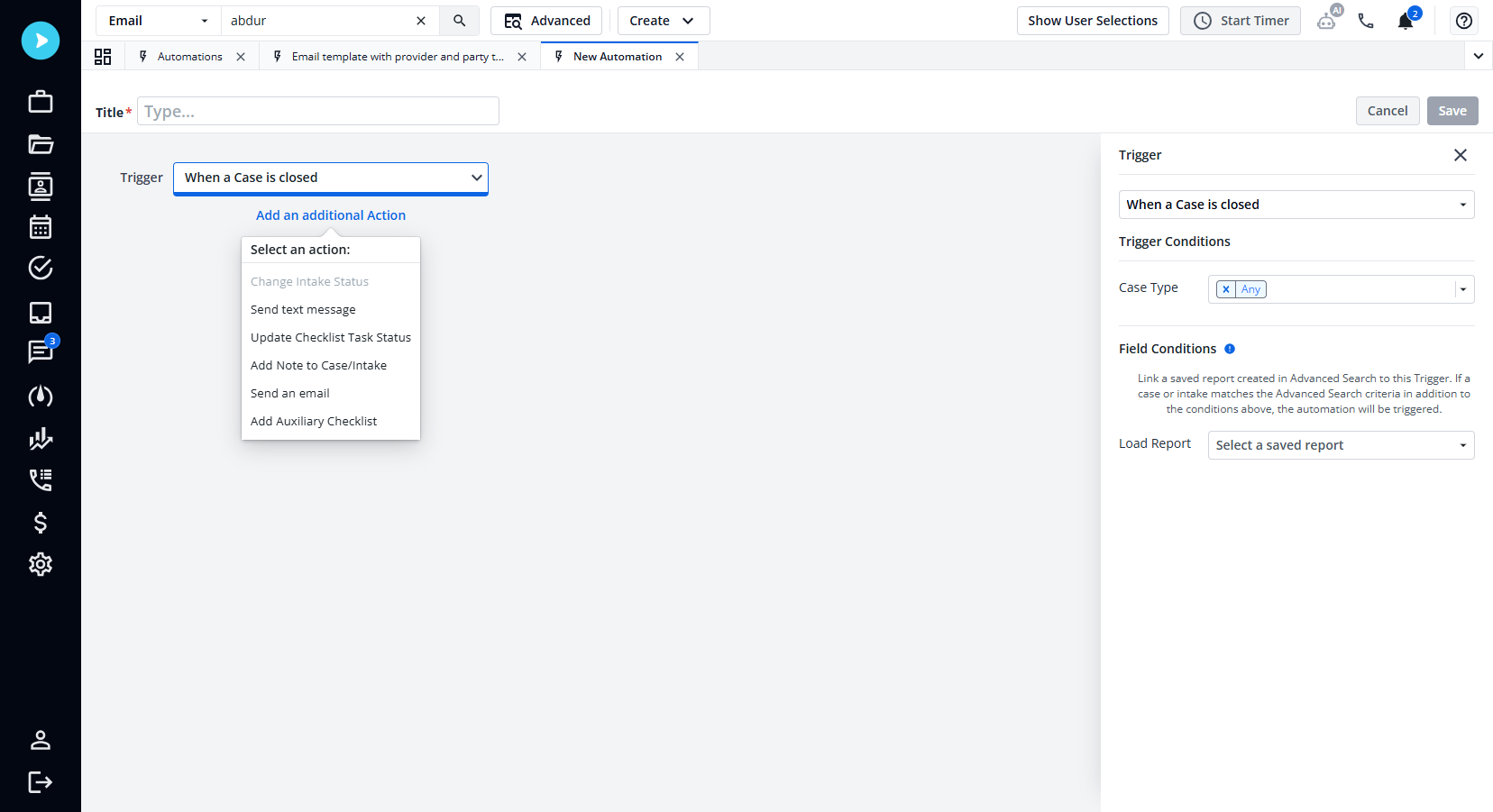
  • New Trigger: Case Closed
    • Users can now create automations that trigger when a case is closed.
      • A new trigger has been added called "When a Case is Closed."
        • Given an automation with this trigger, when a case’s "Case Closed" date field is filled and saved, and the case is marked as "Closed," the automation will run if all other defined conditions are met.
      • Conditions:
        • Case Type – Defaults to "Any" (Required, Multi-Select).
      • Disabled Actions:
        • The "Change Intake Status" action is disabled for this trigger.
          • If the "Change Intake Status" action was already selected, it will be removed when switching to this trigger.
New_Trigger_Case_Closed_Image.png


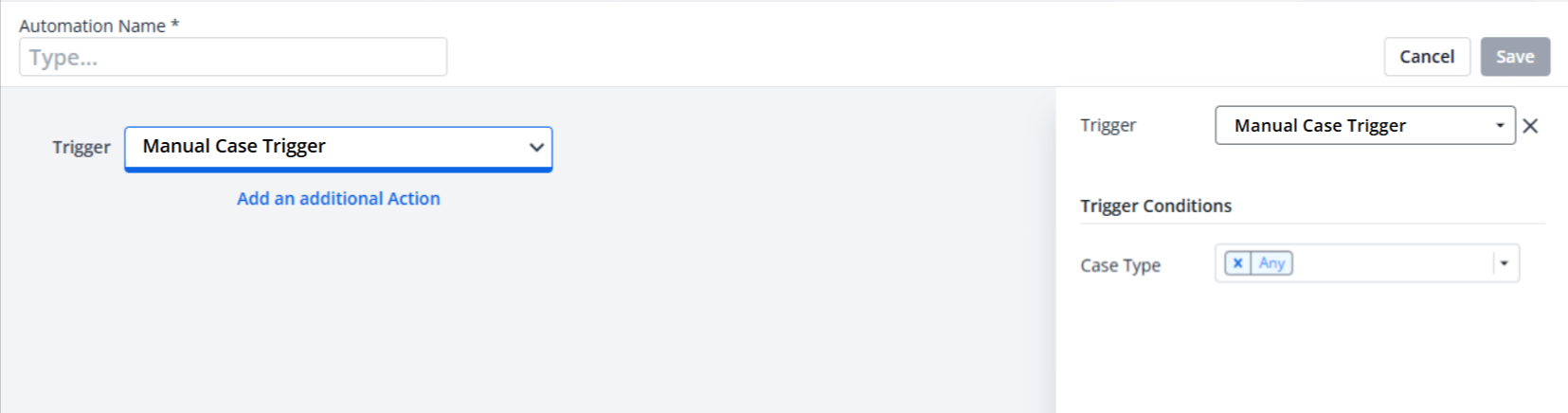
  • Create New Manual Trigger Layout & Add Manual Case Triggers Dropdown to Cases & Intakes
    • Users can create new “Manual Trigger” automations in the Automations Editor and access them in cases and intakes through the “Workflows” dropdown.
      • Using the Case Type Trigger condition field, users can configure the automation to appear for all case types or limit it to specific ones where the manual workflow should be available.
Create_New_Manual_Trigger_Layout_&_Add_Manual_Case_Triggers_Dropdown_to_Cases_&_Intakes_Image.png


NEW AUTOMATION EDITOR

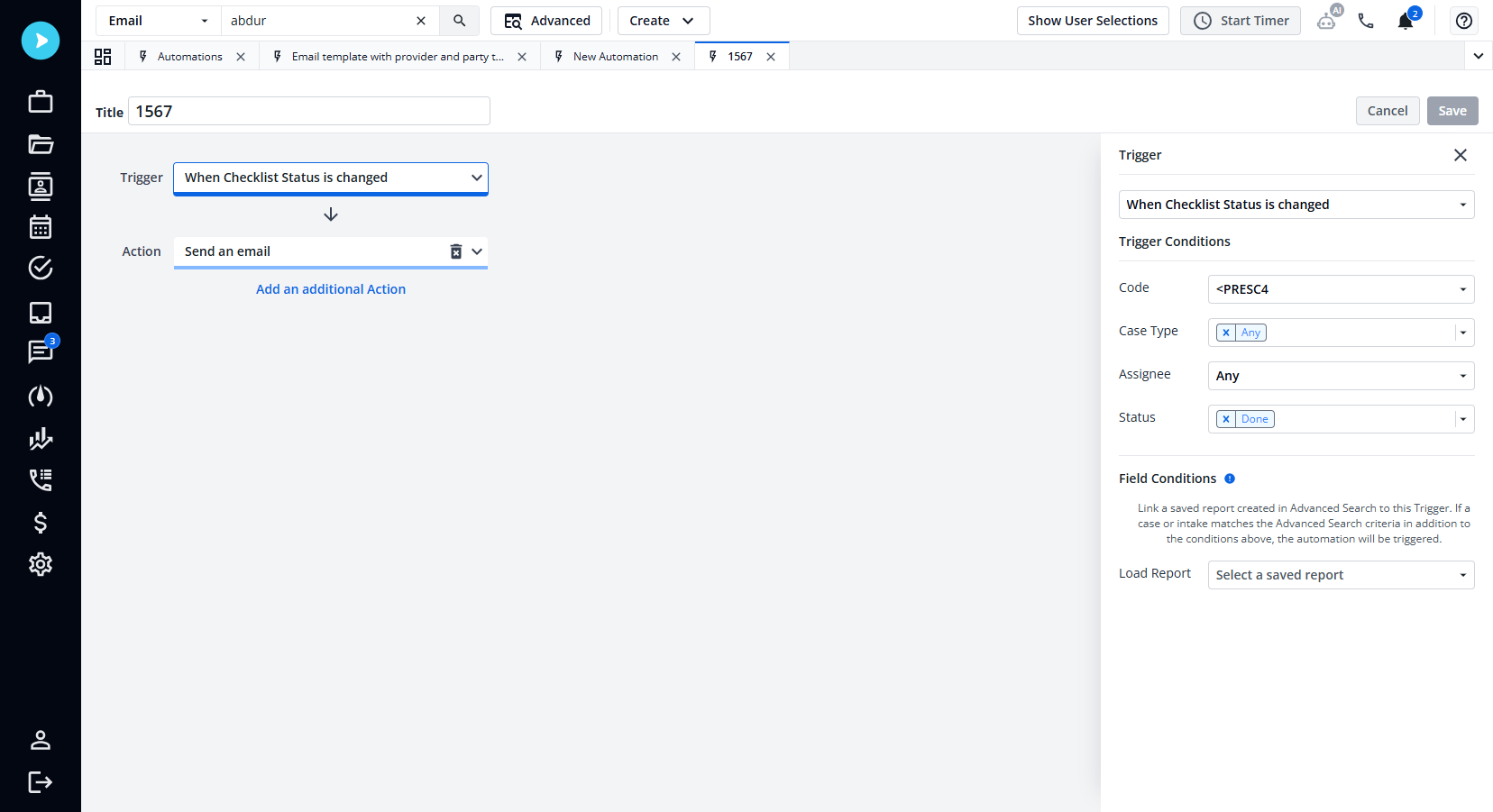
  • Editor Side-Pane UX Updates
    • The Automations Editor side-pane has been updated as follows:
      • Added a Trigger header for clearer organization.
      • Removed the trigger field label and expanded its width to fill the side-pane.
      • Increased the width of Trigger Condition and Action Settings dropdowns.
      • Updated dropdown menus to expand fully and truncate long entries for better readability.
      • Added validation to ensure Checklist Status is a required field.
      • Fixed Save button validation for actions tied to required fields
Editor_Side-Pane_UX_Updates_Image.png


AUTOMATION DISCOVERABILITY

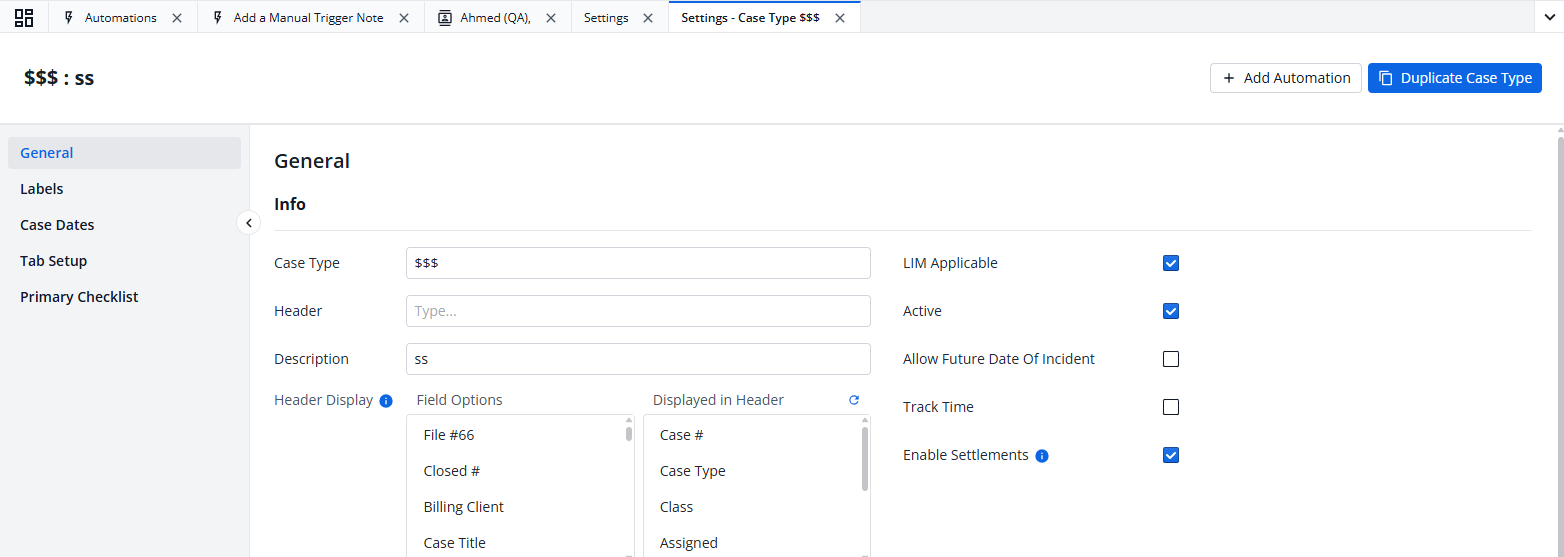
  • Add Automation to Case Type Settings
    • Users can quickly create a new automation using the quick action menu in a case or intake
      • Clicking this button opens a checklist task automation with the current case type automatically selected in the Case Type field.
    • Additionally, the Duplicate Case Type action has been moved out of the 3-dot menu and is now available as its own button in the Case Type header.
Add_Add_Automation_to_Case_Type_Settings_Image.png


  • Create an Automation from a Case (Quick Action)
    • Users can now quickly create a new automation directly from the quick action menu within a case or intake.
      • This option defaults to creating a checklist automation, with the current case type automatically selected in the Case Type dropdown.
Create_an_Automation_from_a_Case_(Quick_Action)_Image.png


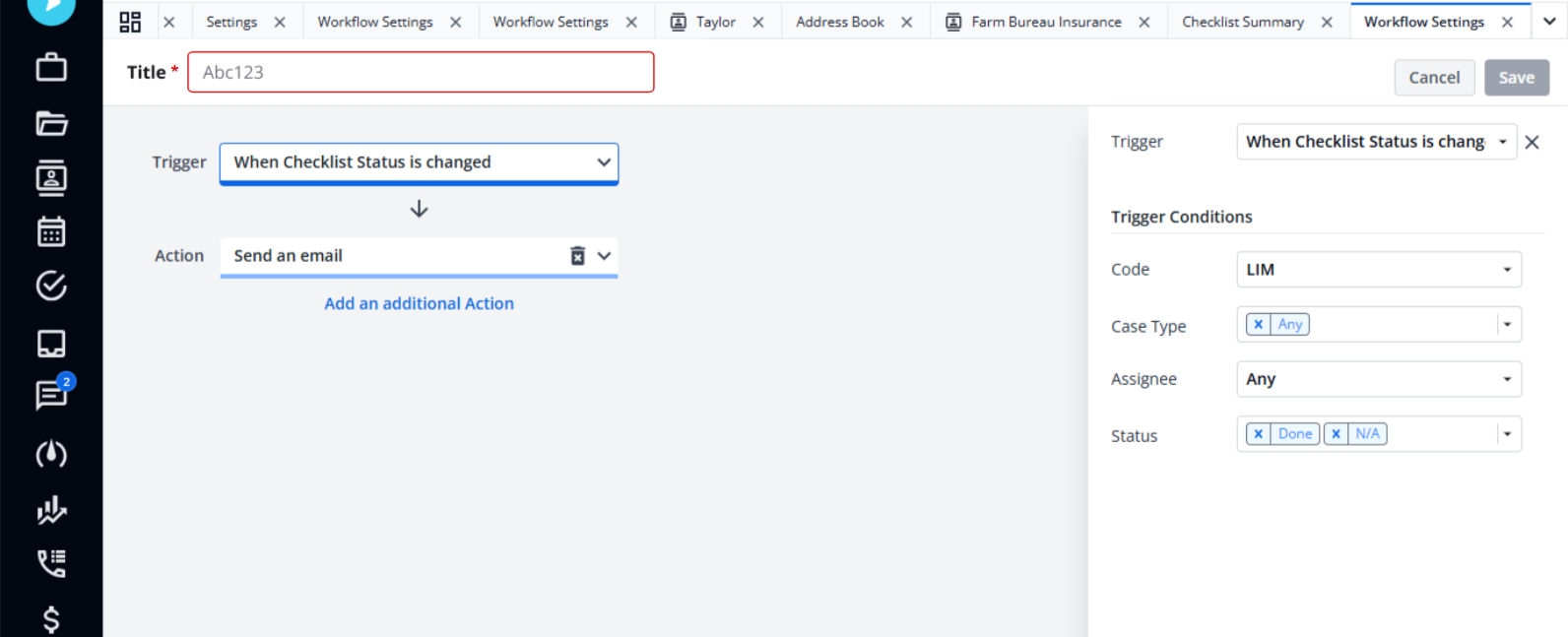
  • Update Automation Editor Title Field Layout and Validation
    • The required field validation for the Automation Title field has been fixed and now displays in red when the field is left empty.
    • The size, layout, and label of the title field have also been updated to improve visibility and usability.
Update_Automation_Editor_Title_Field_Layout_and_Validation_Image.png


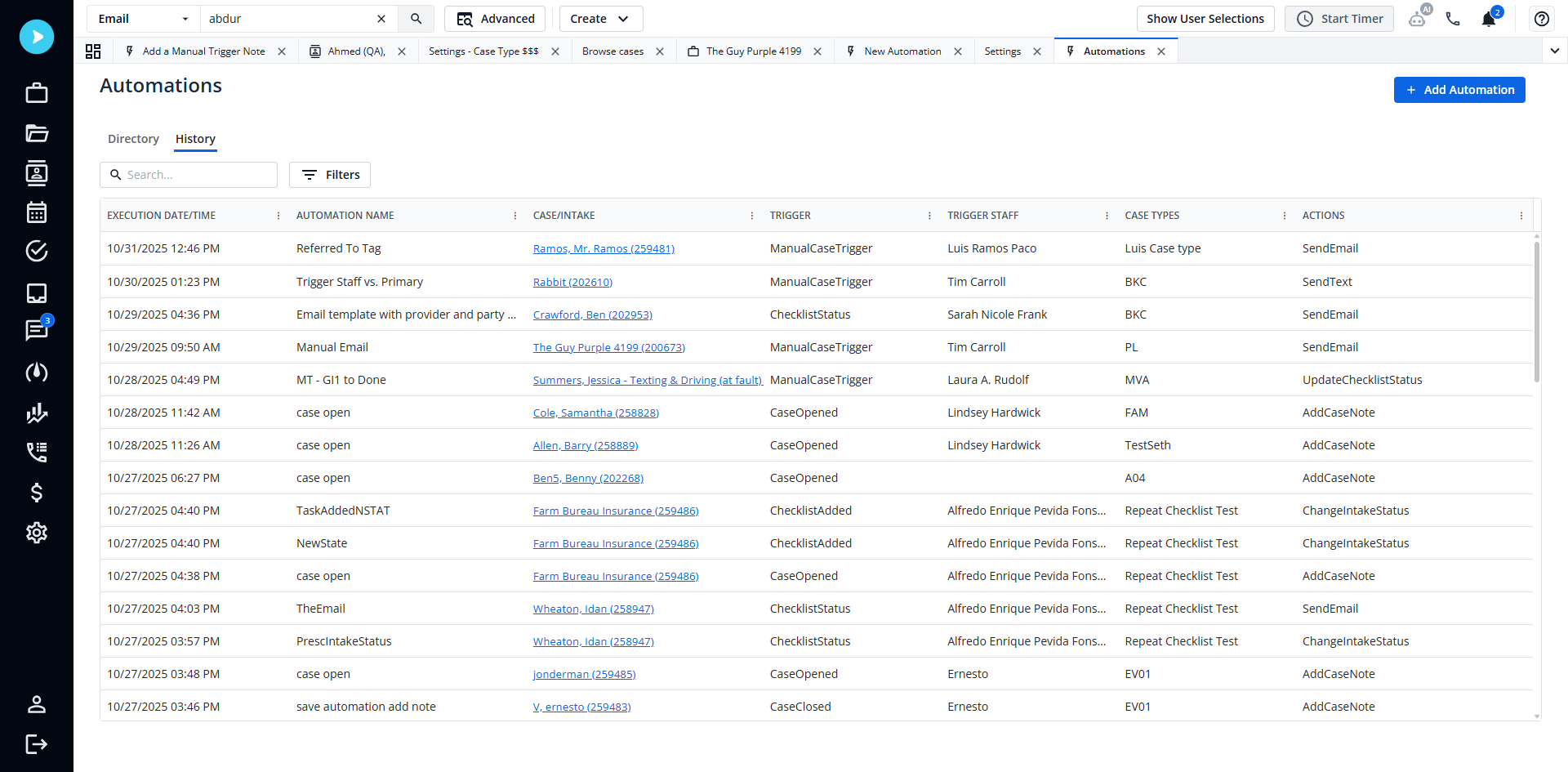
  • Add URL Path & Update Tab Headers
    • Users can now see the automation’s title displayed in the tab header alongside the automation icon.
    • The Automations directory also now includes a unique URL path and tab header for easier navigation and reference.
Add_URL_Path_&_Update_Tab_Headers_Image_1.pngAdd_URL_Path_&_Update_Tab_Headers_Image_2.png


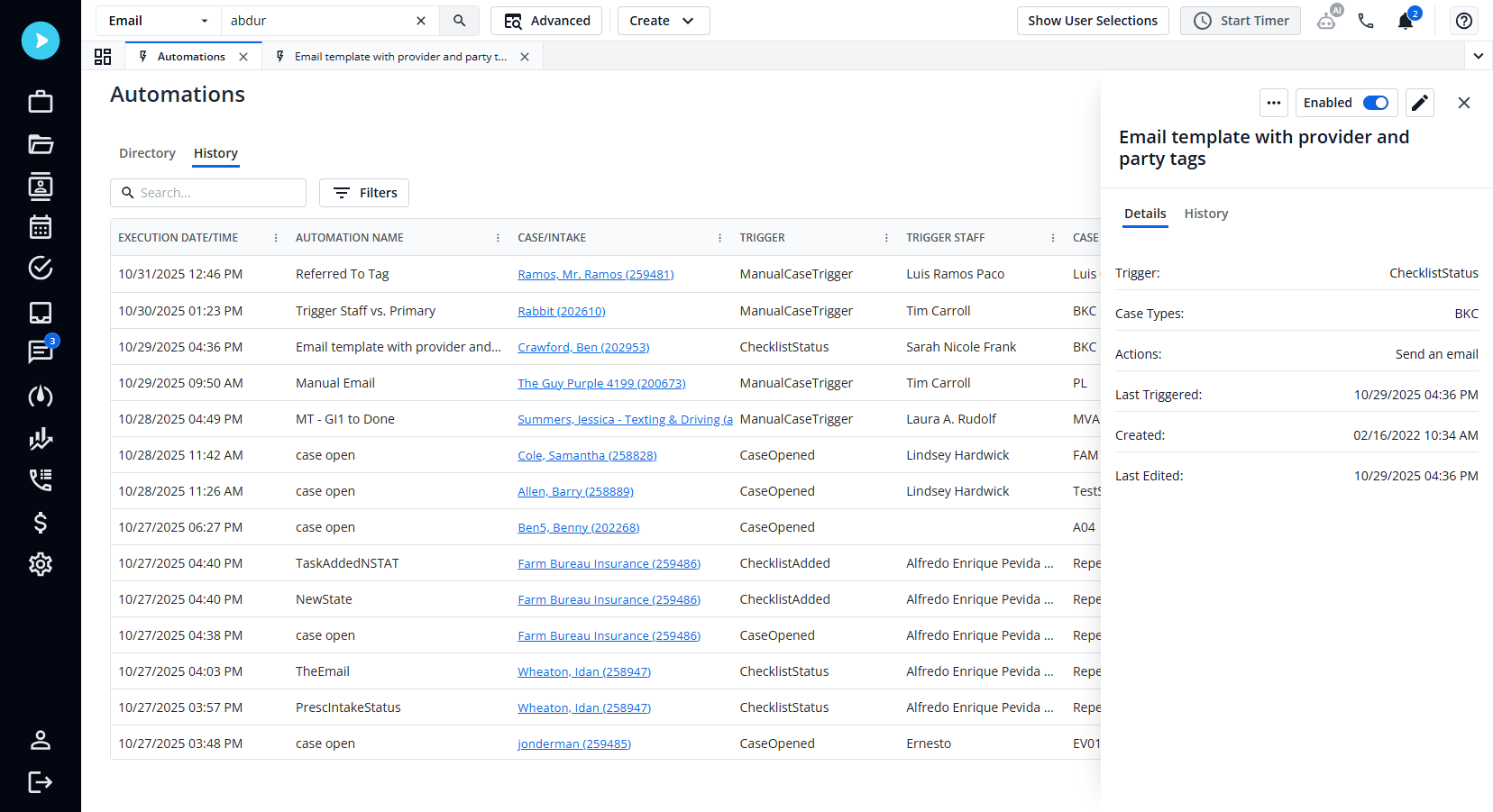
  • Automation Side-pane UX Updates
    • The Automation Directory side-pane layout has been updated to improve readability and ease of use.
    • The automation title area now has more space and will wrap to a second line when needed.
    • The View/Edit option has been removed from the 3-dot menu and replaced with a pencil icon, which opens the automation in a new tab.
Automation_Side-pane_UX_Updates_Image.png


AUTOMATION HISTORY

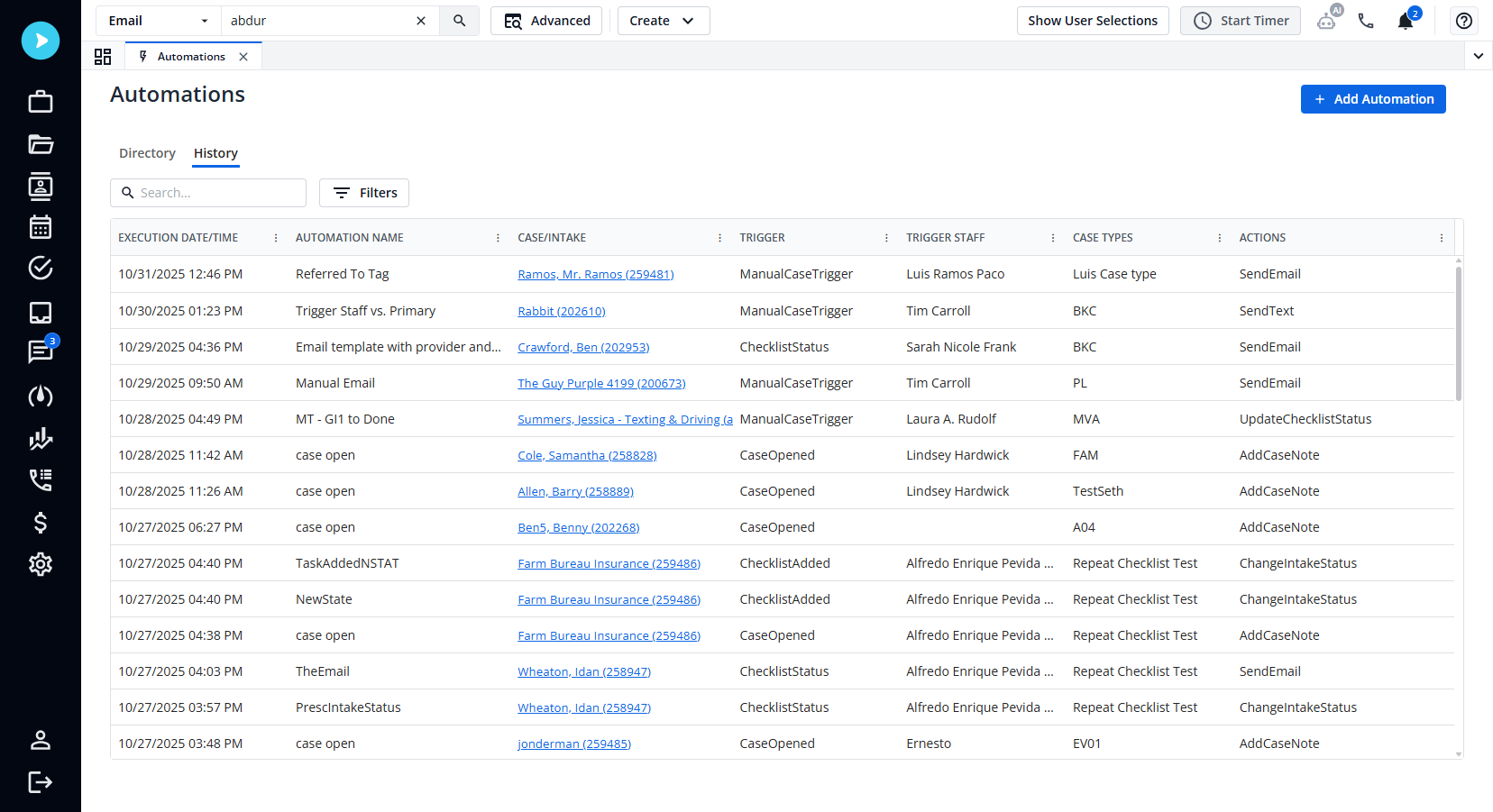
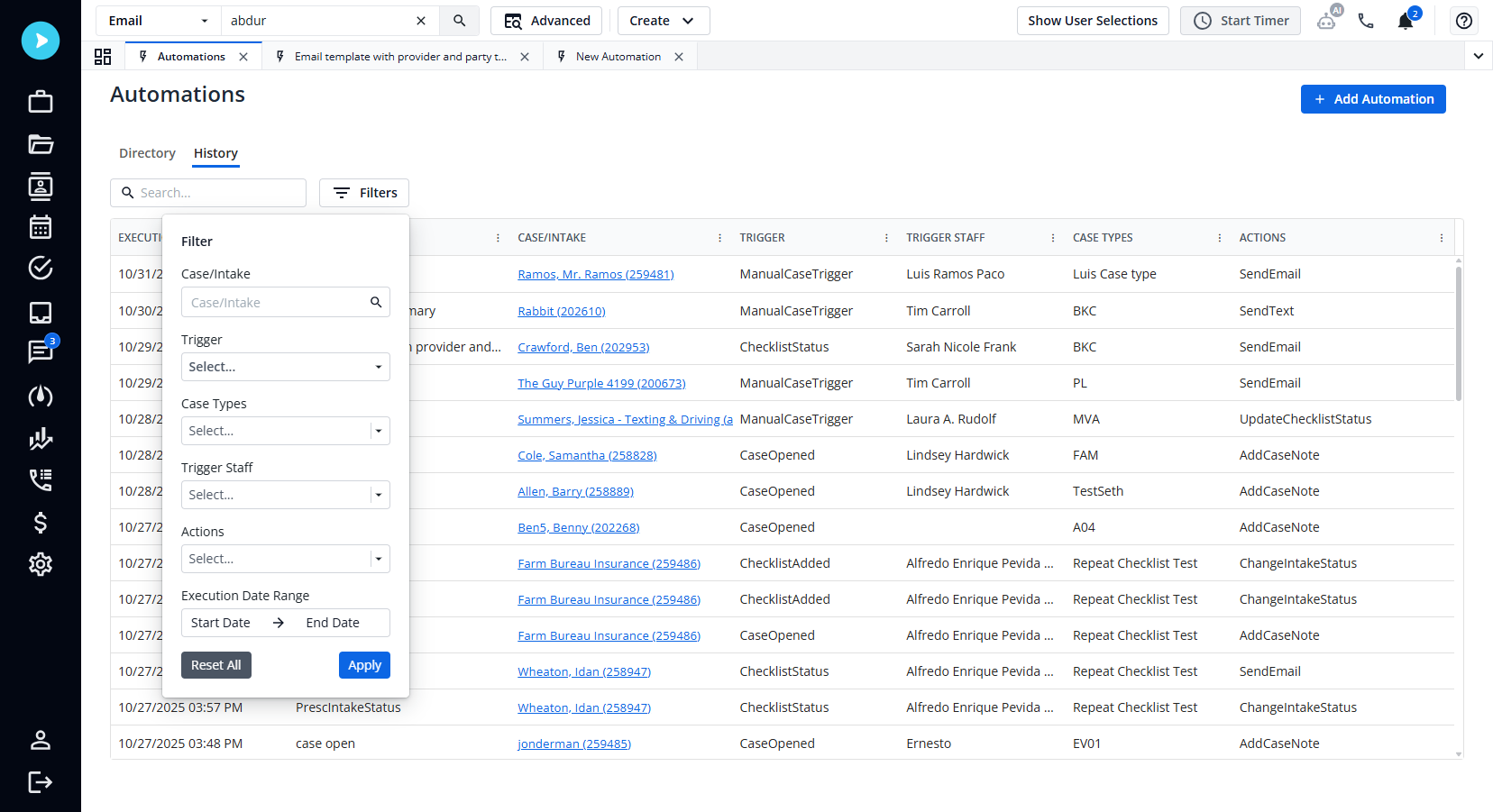
  • Automations Directory History Tab
    • Users can now view a grid displaying all automation executions across the firm.
      • This feature is available as a new tab in the Automations Directory called "History."
        • History Table Columns:
          • Execution Date/Time – Default sort is newest to oldest; can also be manually sorted
          • Case/Intake – Displays the case name for cases and the party name for intakes; clicking opens the case or intake in a new tab
          • Automation Name – Displays the name of the executed automation
          • Trigger Staff – Displays the staff member who triggered the automation
          • Case Type – Displays the case type of the triggering case or intake
          • Trigger – Displays the trigger condition for the automation
          • Actions – Displays all actions within the automation;
        • Single-click opens the automation side-pane from the directory tab, double-click opens it in the editor.
        • Double-click opens it in the editor
Automations_Directory_History_Tab.png


  • Single Automation History
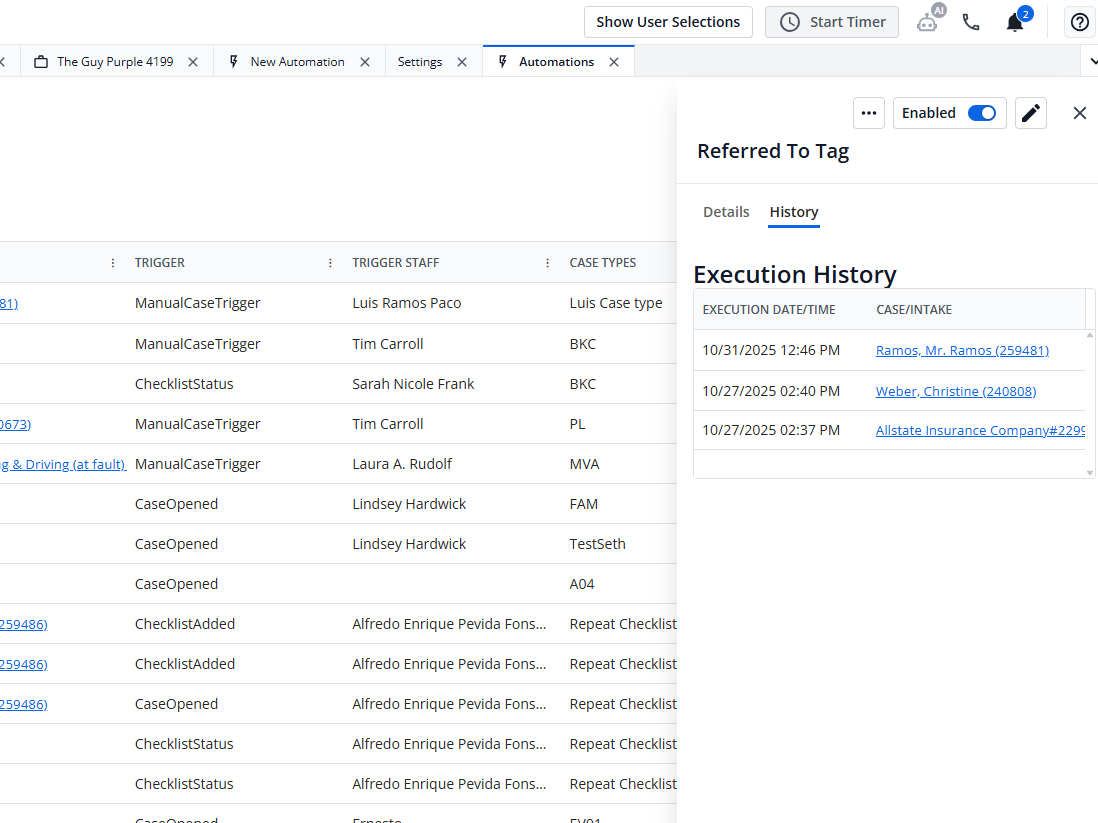
    • Users can now view the execution history of a single automation within the Automation Directory side-pane.
      • The side-pane now includes two tabs:
        • Details – Displays the existing automation details
        • History – Displays a grid of executions, sorted by most recent first
          • History Grid Columns:
            • Execution Date/Time – Displays the time and date the automation was executed
            • Case/Intake Name – Displays as [Case Name] [(Case #)] and links to the corresponding case or intake in a new tab
Single_Automation_History.png


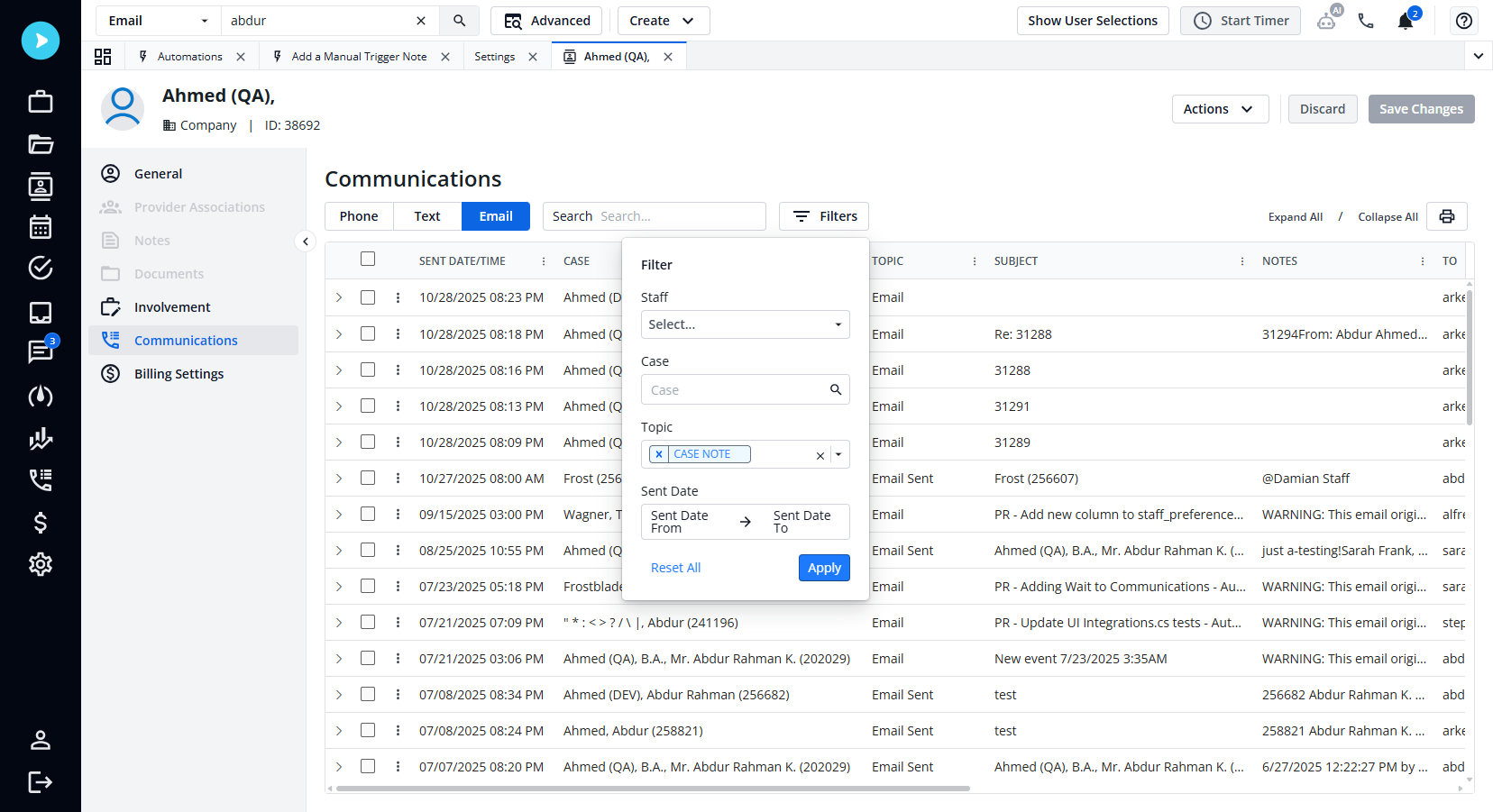
  • Automations History Search & Filters
    • Users can refine results in the Automations History tab using the following filters:
      • Case/Intake – Opens a Select a Case modal (single select). Filters the grid to show all executions linked to the chosen case or intake.
      • Trigger – Single-select filter for the automation trigger.
      • Case Types – Multi-select filter to show executions for cases and intakes matching the selected case types.
      • Trigger Staff – Multi-select dropdown using the staff directory. Filters the grid to show executions triggered by the selected staff members.
      • Actions – Multi-select filter for automation actions.
      • Execution Date Range – Date range picker (same component as the Global Text Messages grid) that filters executions by date.
    • Users can use a text search bar that searches the automation Name field
Automations_History_Search_&_Filters.png


NEW CONDITIONS - CUSTOM FIELD CONDITIONS as QUERIES
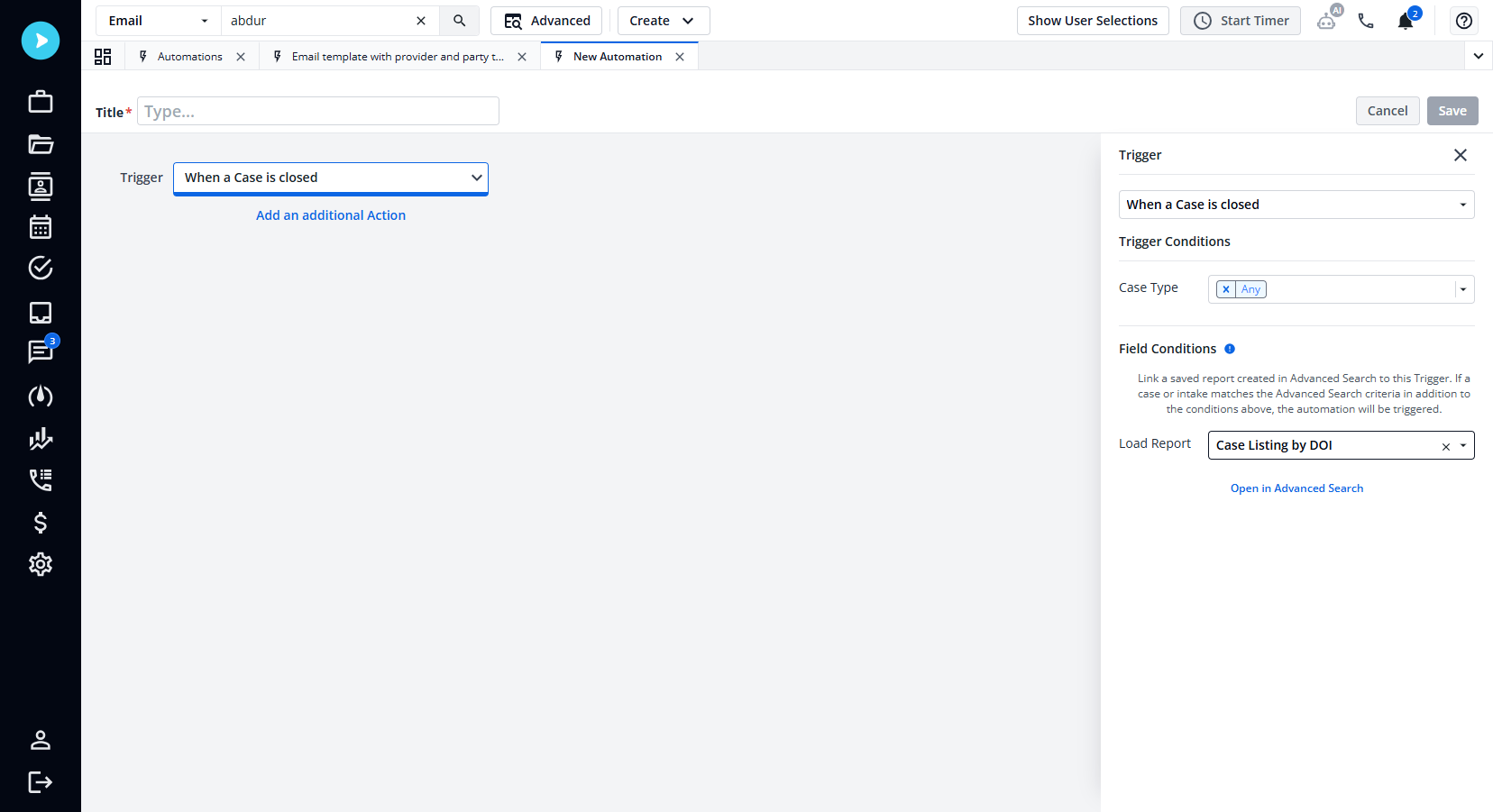
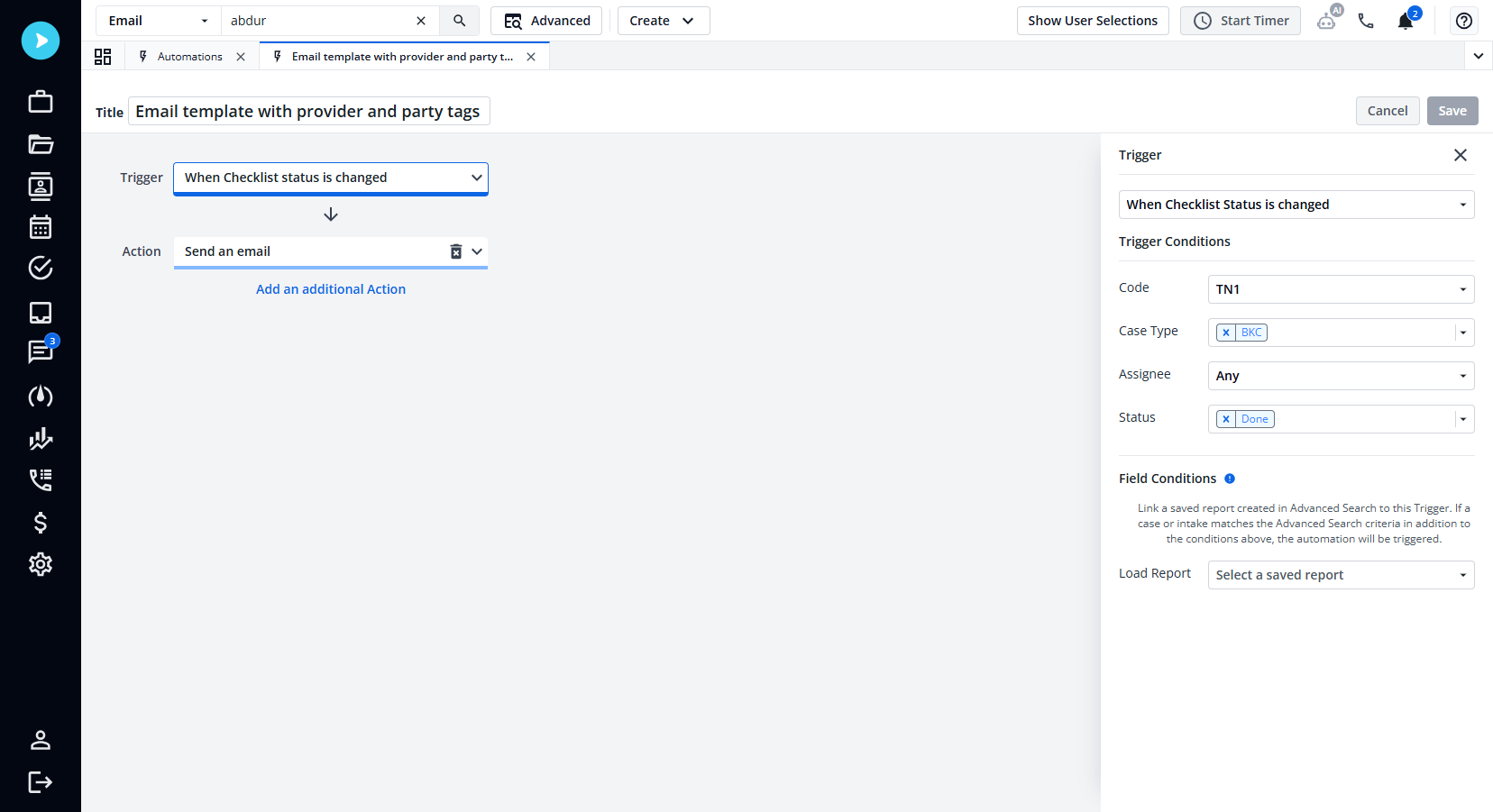
  • Adding an Advanced Search Report/Query as an Automation Condition
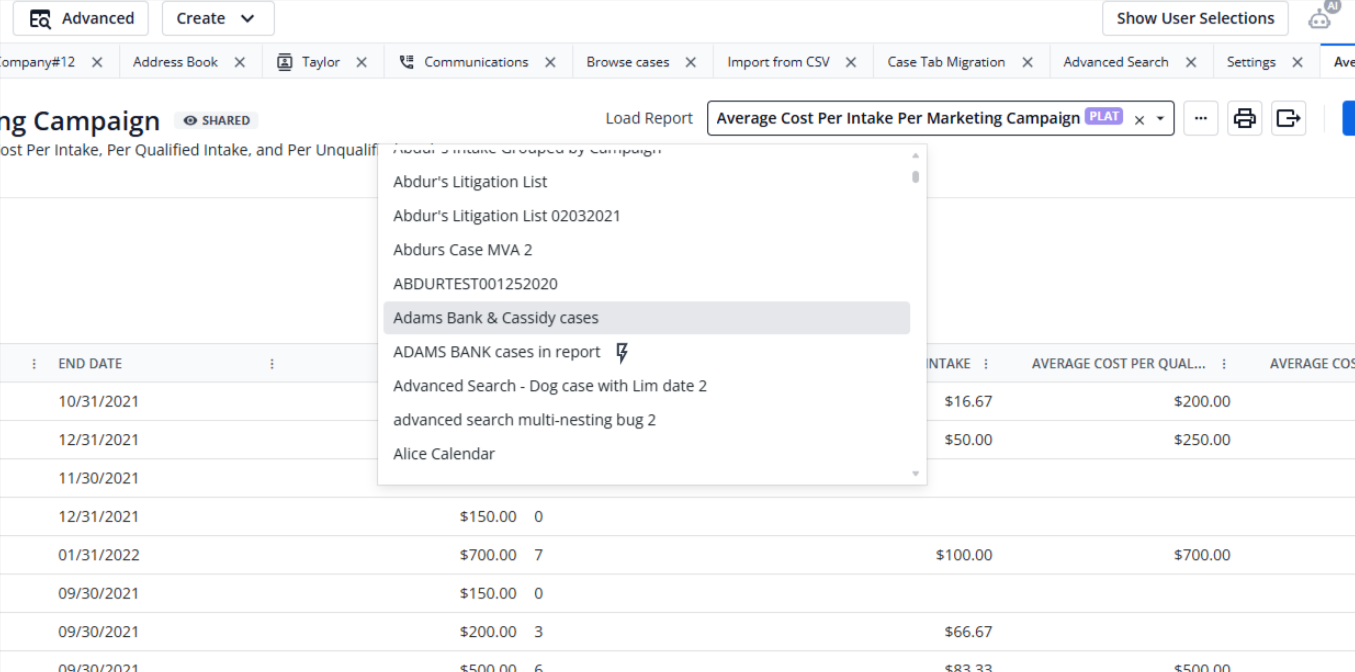
    • Users can associate an automation trigger with a saved Advanced Search Report through a new "Field Conditions" section in the automation editor side-pane.
      • New "Field Conditions" Section in the automation editor trigger side-pane screen
      • Load Report dropdown – Displays only shared reports where “Search For” is Intakes, Cases, or Intakes & Cases.
        • Users without the General > Reports permission will not see any reports in the dropdown.
        • Given a user is creating or editing an automation, when they select the Load Reports dropdown in the trigger condition side-pane, then the list will display only shared reports where the "Search For" option is set to Intakes, Cases, or Intakes & Cases.
        • After a report is selected, an “Open in Advanced Search” link appears, opening the report in a new tab for quick review.
        • When the automation is triggered, the fields defined in the selected Advanced Search report are evaluated for the trigger case or intake.
        • The automation runs only when both the default trigger conditions and the Advanced Search query conditions are met (i.e., the case or intake appears in the report results).
Adding_an_Advanced_Search_Report_Query_as_an_Automation_Condition.png


  • Editing or Deleting Advanced Search Reports Linked to Automations
    • Reports linked to at least one automation display an automation logo in both the Load Report dropdown in Advanced Search and the Reports AG Grid Name column (similar to the PLAT reports pill).
    • Editing Linked Reports
      • When a user edits a report linked to an automation and clicks Save Changes, a yellow warning modal appears:
        • Text: “Edit Report Linked to Automation? Are you sure you want to edit this saved report? This report is currently used as a field condition in one or more automations. Editing it may impact how those automations run.”
        • Selecting “Yes” saves the changes.
        • Selecting “No” cancels the save and leaves the report unchanged.
      • If a user turns off “Share Report” for a shared report linked to an automation and confirms, the report becomes private and is removed from the automation.
    • Deleting Linked Reports
      • When a user attempts to delete a linked report (either from the Advanced Search 3-dot menu or from the Reports Directory), a red warning modal appears:
        • Text: “Report Linked to Automation. This report is currently being used as a field condition query for one or more automations. Deleting this report will impact how those automations run.”
        • Selecting “Delete” confirms and removes the report.
        • Selecting “Cancel” closes the modal without deleting.
      • If a linked report is deleted, the Field Conditions report field in the automation is cleared, and the automation continues to trigger based on its default conditions.
Editing_or_Deleting_Advanced_Search_Reports_Linked_to_Automations.png


Advanced Search 

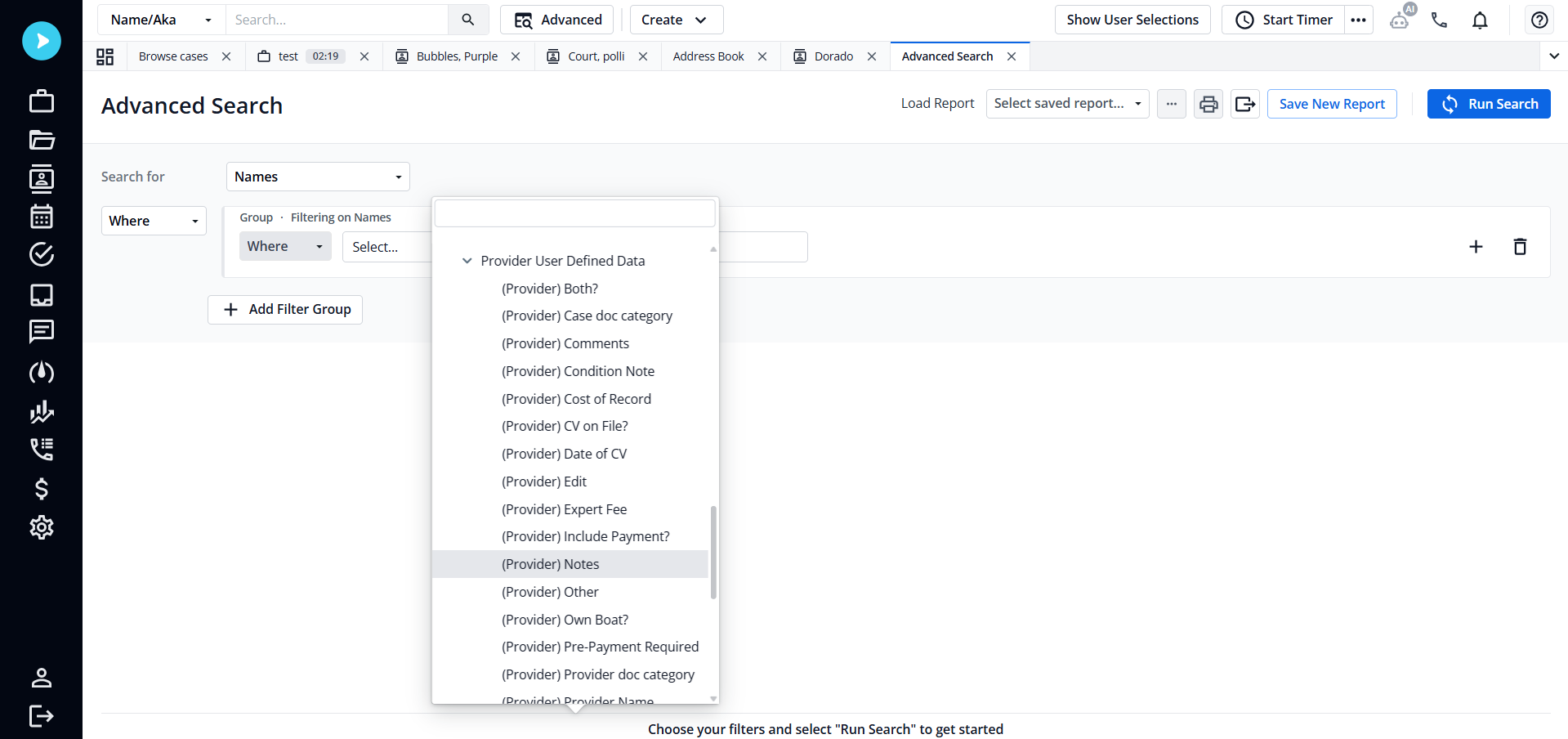
Enhancements include a new Last Activity column for Browse Cases (mirroring Browse Intakes), clearer conjunction operators and list-based filters, and new Provider User-Defined Field (UDF) options when performing a Names > Provider search.
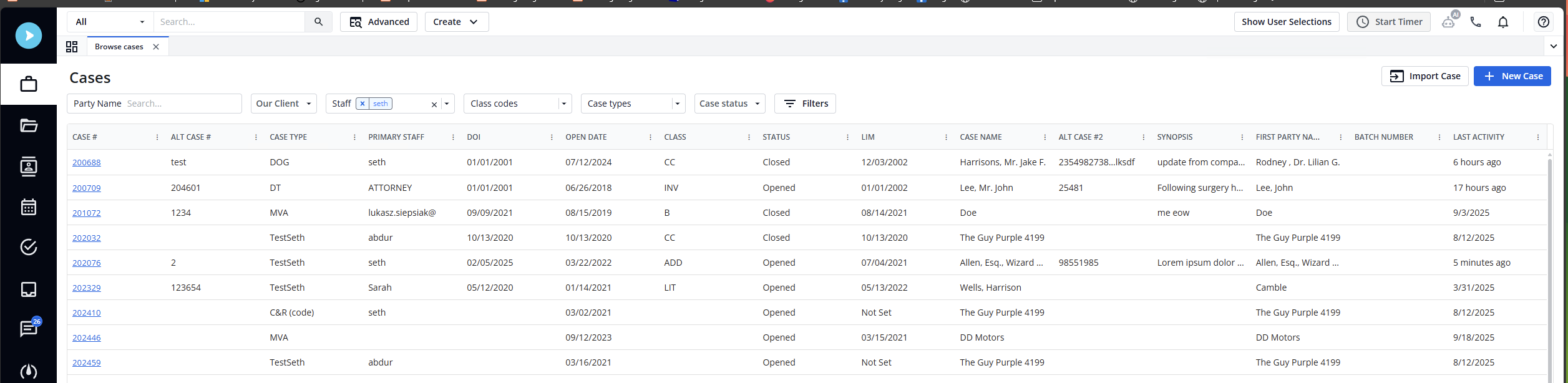
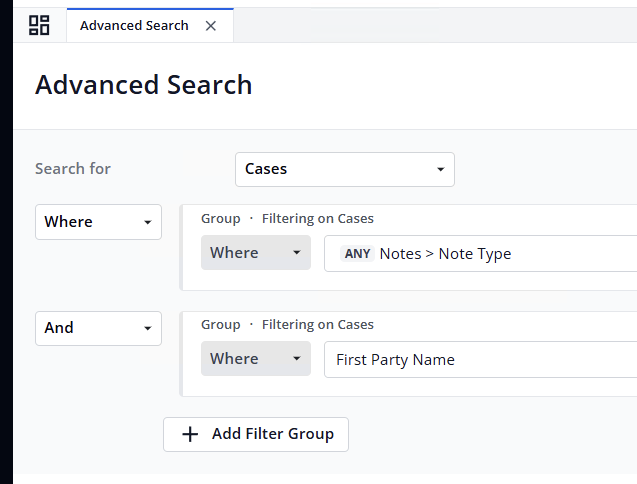
  • Improves visibility into case activity with the new “Last Activity” column in browse cases, helping users quickly identify recent updates or actions.
  • Enhances usability and reduces confusion through clearer display of conjunction operators and list-based filters in the interface.
  • Updated “Last Update Time” to Apply to Cases
    • A new “Last Activity” column has been added to Browse Cases.
    • Functions the same way as the existing column in Browse Intakes.
    • Whenever there is any activity on the case (for example, a change on the Case tab, a new note, or a document deletion), the Last Activity timestamp updates to “Now”.
    • In Advanced Search, users can filter by or display the “Last Update Time” column for both Intakes and Cases.
Updated_“Last_Update_Time”_to_Apply_to_Cases_Image.png


  • UI Updates for Advanced Search: Improved Clarity for Operators and List Filters
    • Conjunction operators (AND / OR) have been moved outside of groups so it’s visually clear which conditions they apply to.
    • An ANY tag has been added to list-based filters (such as Notes, Value Items, etc.) to clearly indicate that the condition applies to any item within that list that meets the specified criteria.
UI_Updates_for_Advanced_Search_Improved_Clarity_for_Operators_and_List_Filters_Image.png


  • User Defined Fields for Provider Search
    • When conducting a search by Names, the Select… dropdown now includes a new section called Provider User Defined Data.
      • Displays all custom fields configured in Layout Manager > Provider.
      • Fields are grouped beneath Names > Provider for easier navigation.
    • After running a Names search, the Columns menu includes:
      • All provider user-defined fields, listed alphabetically.
      • Each field is prefixed with “(Providers)” for clear identification.
User_Defined_Fields_for_Provider_Search_Image.png


Case Checklist: Side Pane Updates 

Enhancements improve clarity, layout, and change management in the checklist side pane.

Users can more easily identify task types, modify checklist codes without losing data, and clearly manage changes with visual prompts and confirmations—reducing accidental deletions, missed updates, and overall workflow friction.
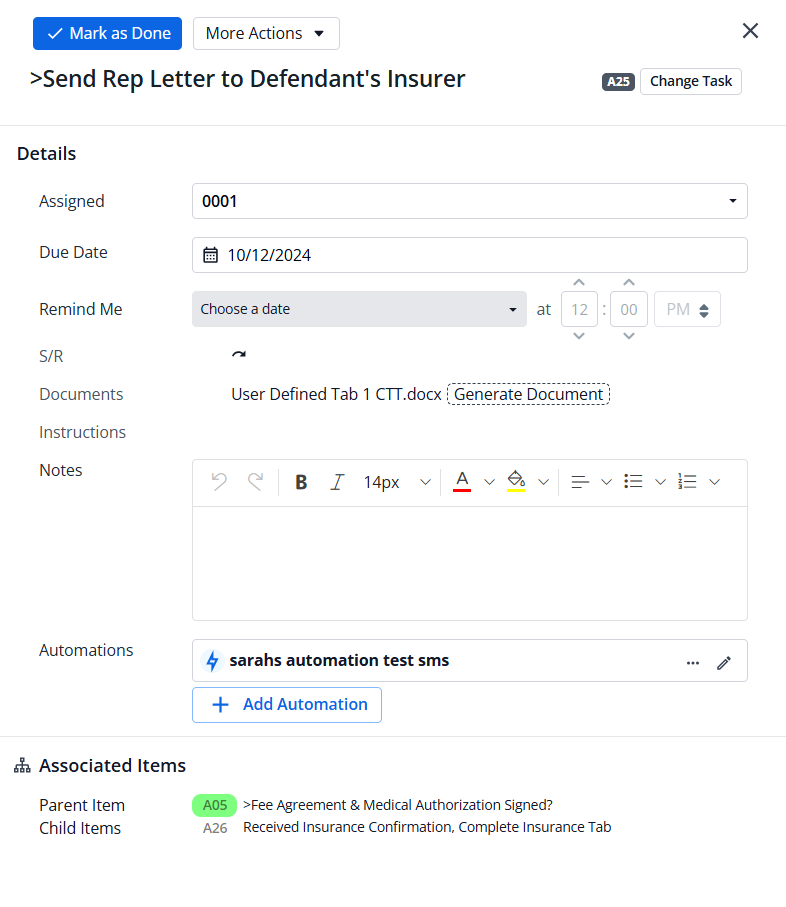
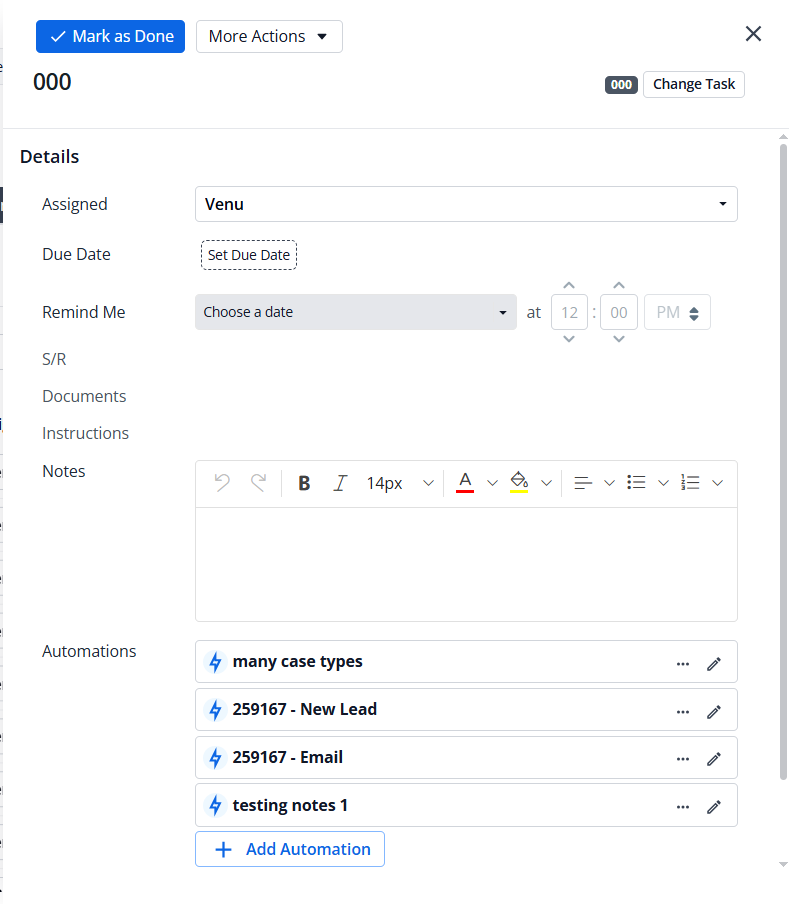
  • Task Type now appears as a pill between the Task Name and the Change Task button
  • Clicking Change Task allows users to update the checklist code of a checklist item and select from their firm’s list of Checklist Codes.
    • All user-entered information is retained after changing the task.
  • The +Add Automations button has been redesigned.
  • The parent/child checklist item layout has been updated to a stacked design for better readability.
  • Active Automations on checklist items now display an ellipse and pencil icon
    • Selecting the ellipse opens a Delete option
    • When deleting, a confirmation modal appears:
      • Title: Delete Automation
      • Body: "Deleting this automation will remove it for all checklist items with matching trigger conditions in Neos. Deleting can’t be undone."
    • Disabled Automations no longer appear in the list of automations associated with the checklist item.
    • When editing a checklist item in the side pane, users now see Save Changes and Discard buttons to manage updates.
      • Save Changes keeps edits
      • Discard removes them
    • If a user makes changes and clicks the X to close the side pane, an Unsaved Changes modal is displayed:
      • Title: Unsaved Changes
      • Body: "There are some unsaved changes. Are you sure you want to leave?"
Case_Checklist_Side_Pane_Updates_Image_2.pngCase_Checklist_Side_Pane_Updates_Image_1.png


Attachment Handling for Calendar Events 

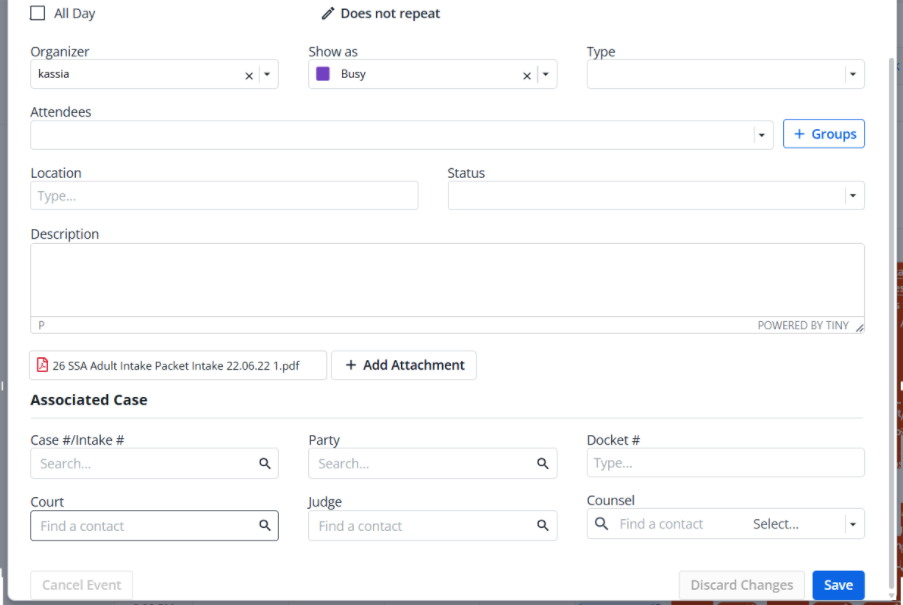
Users can now view, add, and remove attachments to calendar events in Neos.

Customer Requests #4134, 3660, 2459, 931, 968

Lets you keep important documents directly linked to events for better context and time savings. A few attachment use cases include:
  • Client paperwork or intake summaries for a consultation meeting
  • Case brief, motion filings, exhibits, witness lists, etc. for a court appearance
  • Deposition questions and prior testimony details for a scheduled deposition
  • Settlement documents for a settlement conference
  • When creating or editing an event in Neos, users can now add attachments that will also appear in Outlook.
  • Users can also remove attachments directly from an event by selecting the ‘x’ icon within the attachment.
    • Important: When an attachment is removed using the ‘x,’ it is permanently deleted from the event immediately — regardless of whether the user later saves or discards changes to the removal.
    • Attached files can be opened and viewed directly from the event in either Neos or Outlook.
Attachment_Handling_for_Calendar_Events.png


Outlook Webhooks Subscription Management (Beta Testing) 

Firms with this module enabled can now subscribe to Outlook webhooks either at the firm level or for individual staff profiles. This allows near real time syncing of calendar when changes are made in outlook.

For firms that primarily edit their calendar events in Outlook rather than Neos, this will provide quicker calendar updates to Neos to more seamlessly reflect the changes made in Outlook.

  • To subscribe for an individual staff member, open the staff profile and select Subscribe. This enables two-way syncing between that staff member’s Outlook calendar and Neos.
  • To subscribe the entire firm, go to Firm Preferences > Default Info and select Subscribe. This activates two-way syncing for all staff calendars for 24 hours from the time of subscription.
    • Please Note: After 24 hours, the subscription will automatically expire and can be renewed as needed.


**At this time, this enhancement is in beta testing with the following customers: Turner Law Offices/Star Casualty Insurance Company/Paulson & Nace/Ransin Injury Law/Brad Bradshaw MD/McKeen & Associates/Burnetti PA/Davis Law Group/Godsey & Martin/Herman Law/Kemper Corporation

**Once beta testing is successfully completed, this enhancement will be made available to all customers in a future release.

Outlook_Webhooks_Subscription_Management_(Beta_Testing)_Image_2.pngOutlook_Webhooks_Subscription_Management_(Beta_Testing)_Image_1.png


Auto Populate Alternate Case Number 

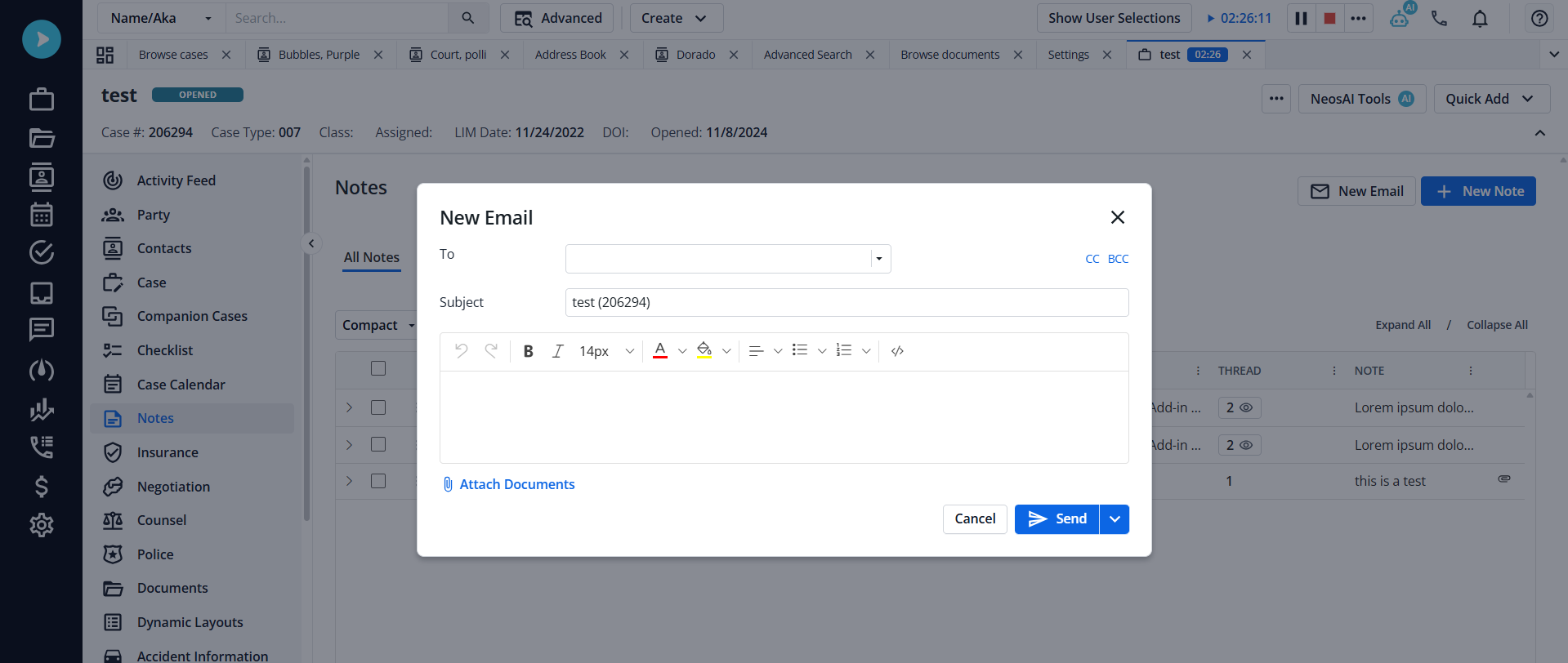
A new firm-level preference lets users choose which case number automatically appears in the subject line when sending emails or creating case calendar events.

Customer Requests #741, 1084

It ensures consistency across firm communications and saves time by automatically inserting the preferred case identifier. It also reduces manual entry errors when using alternate case numbering systems.
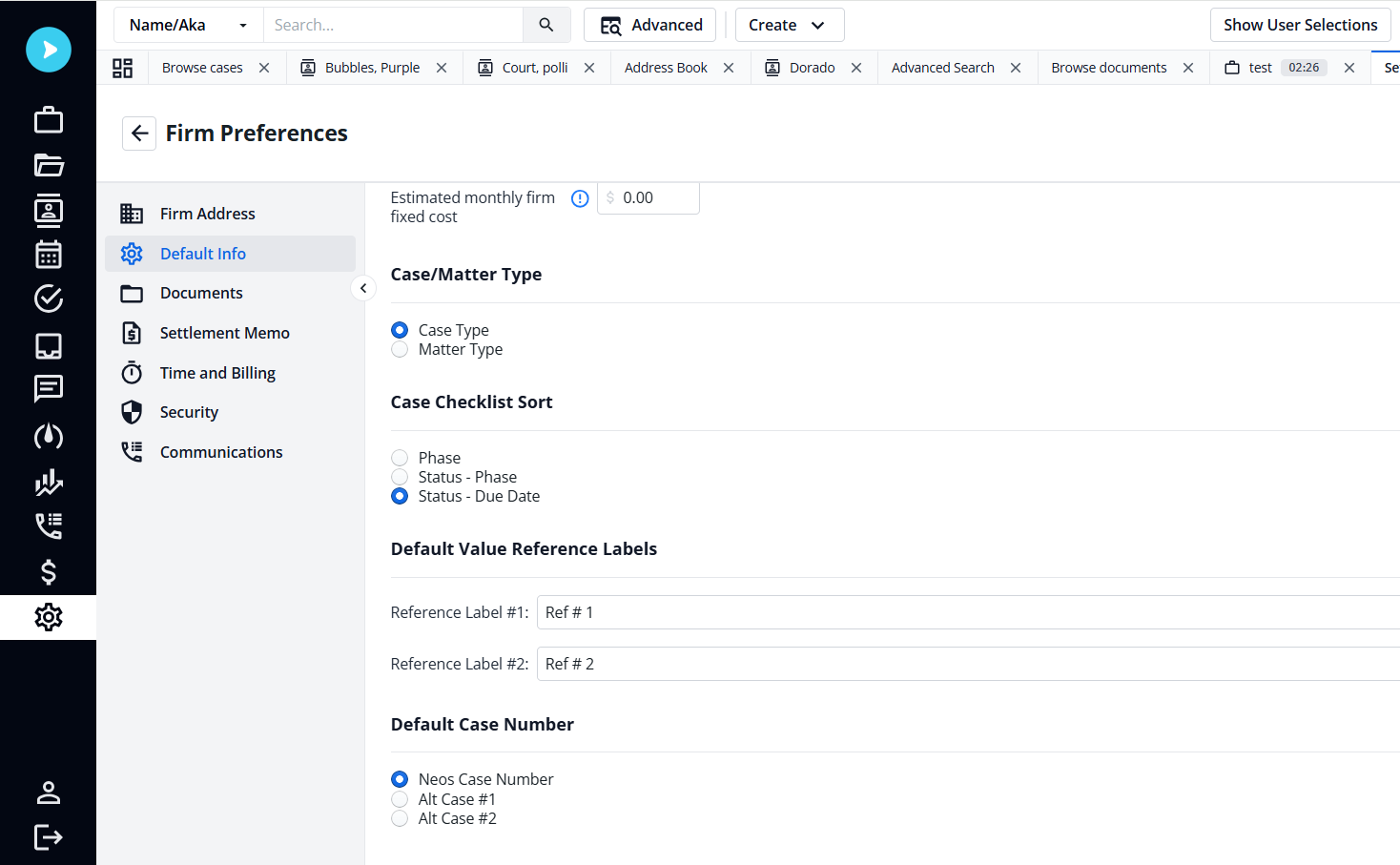
  • A new Default Case Number section has been added under Settings > Firm Preferences > Default Info.
    • Users can select one of three options:
      • Neos Case Number
      • Alt Case #1
      • Alt Case #2
    • The selected case number automatically prepopulates in the subject line when:
      • Drafting a new email within a case
      • Emailing documents from a single or multiple cases
      • Creating a case calendar event
    • Workflows impacted by this enhancement:
      • Case – Quick Add – Send Email
      • Case Calendar – New Event
      • Case – Notes – Send Email
      • Documents and Case Documents – Single Document Selected – Bulk Action
      • Documents and Case Documents – Multiple Documents Selected – Bulk Action
      • Case Documents – Details Dropdown Arrow – Email
      • Notes – Three Dot Menu – Email
    • If Alt Case #1 or Alt Case #2 is selected but no value exists in that field, Neos automatically defaults to the Neos Case Number.
Auto_Populate_Alternate_Case_Number_1.pngimage-20251104-004200.png


Cost Items in LEDES Files: Add Unit/Cost/Quantity as Editable Fields in Value Entry 

It allows users to edit key fields for value entries that are not time-type, giving them greater flexibility in managing costs and quantities.
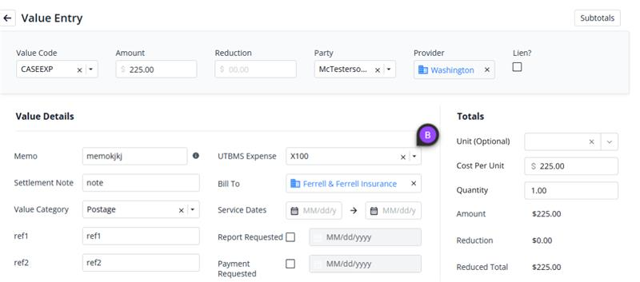
  • Increases flexibility and control over billing data by allowing direct edits to cost and quantity fields after entry creation.
  • Enhances billing accuracy by ensuring adjustments to quantity and rate are displayed in invoices.
  • Applies to value entries that are NOT time-type:
    • Users can edit unit, cost, and quantity.
    • Updating cost or quantity automatically updates the amount.
    • Changing the unit does not update the final amount.
    • Updating the amount adjusts the cost to keep the calculation correct.
    • These fields can only be edited after the value entry has been created.
Cost_Items_in_LEDES_Files.png


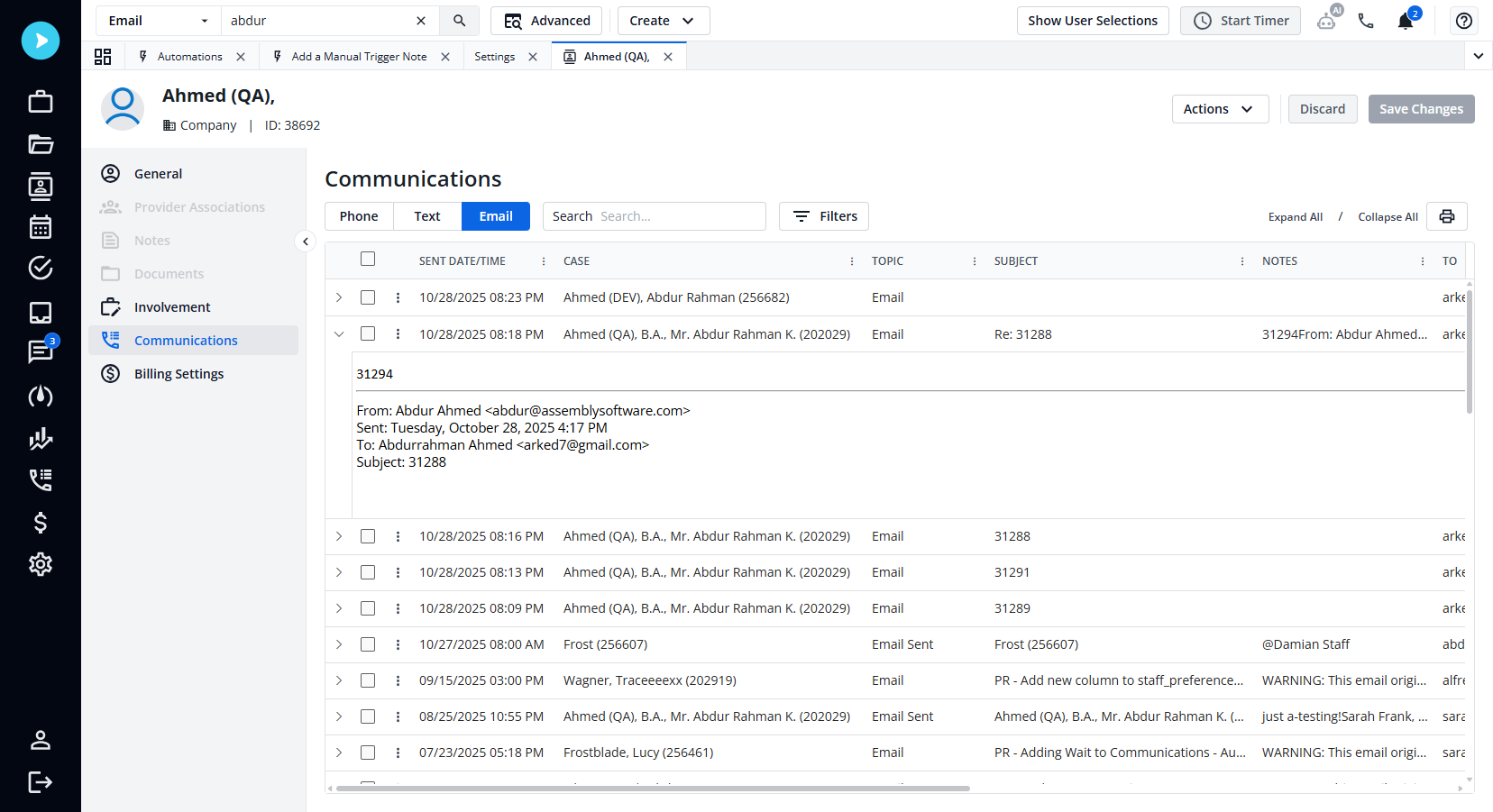
Contact Communications Tab Updates - Emails 
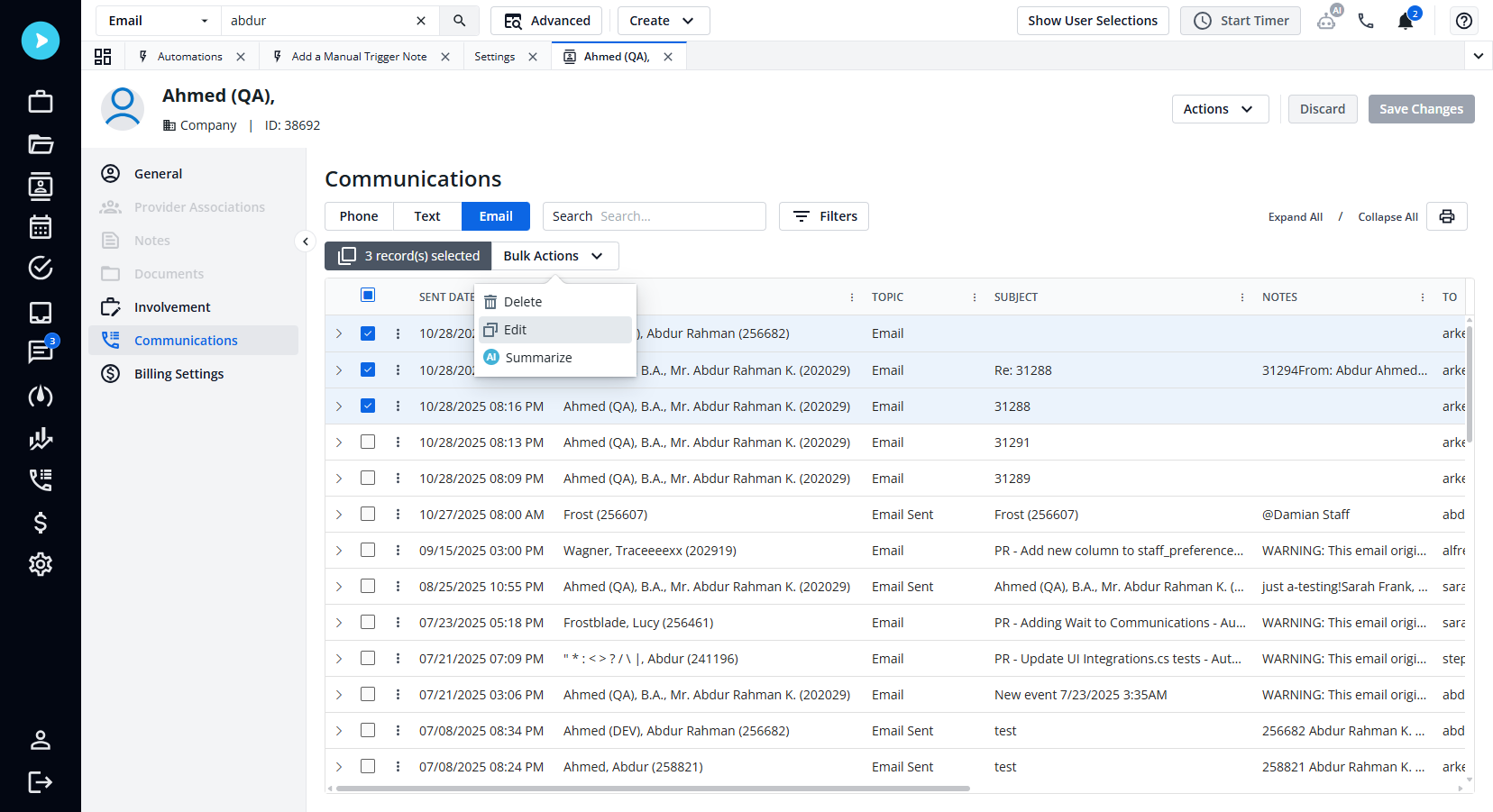
  • These updates enhance the Contact Communications tab by adding a new Email grid with full search, filter, and action capabilities.
  • Users can now view all emails associated with a contact, search and filter by key details, and take actions such as reply, forward, edit, delete, or summarize—all from one place.
  • These improvements provide a centralized, efficient way to manage and track all communication history for a contact, improving visibility and productivity across cases
  • Email Grid Columns
    • The Email tab displays all email correspondence sent to or from any of the email addresses linked to a contact in Neos.
    • It includes:
      • Case email notes tagged from Outlook where any of the contact’s emails appear as a recipient (To, CC, or BCC) or sender
      • Case email notes sent from Neos where any of the contact’s emails are recipients
    • The grid layout and behavior are similar to the Case > Notes > Emails tab.
    • Double-clicking a note opens it in a new tab inside the case where it’s tagged.
    • Only the Sent Date/Time column is sortable.
Email_Grid_Columns.png


  • Email Grid Actions
    • Users can perform both single and bulk actions on email notes in the Contact Communications tab.
    • Single Note Actions:
      • View Note – Opens the case in a new tab with the selected note displayed in detail view (different behavior from case notes).
      • Download Email – Downloads the email as a .eml file.
      • Reply – Opens a reply in Outlook Web.
      • Reply All – Opens a reply to all participants in Outlook Web.
      • Forward – Opens a draft forward email in Outlook Web.
      • Delete – Opens the “Delete Note(s)” modal. Selecting “Yes” deletes the note and refreshes the grid. Requires Provider > Communications Tab > Can Delete and Case > Notes Tab > Can Delete permissions.
    • Bulk Actions (follow existing Notes tab logic unless otherwise specified)
      • Delete – Opens the “Delete Note(s)” modal. Selecting “Yes” deletes the selected notes and refreshes the grid. Requires Provider > Communications Tab > Can Delete and Case > Notes Tab > Can Delete permissions.
      • Edit – Opens the “Update Note(s)” modal. Selecting “Save” applies updates, closes the modal, refreshes the grid, and displays a confirmation toast. Requires Provider > Communications Tab > Can Modify and Case > Notes Tab > Can Modify permissions.
      • Summarize – Launches the AI Note Summary creation in the background. This option appears only if the firm’s AI module is enabled and the user has NeosAI special permissions.
Email_Grid_Actions.png


  • Email Grid Search & Filters
    • Users can search and filter email notes for a contact using the following options:
      • Case – Single-select, searchable case field that filters the grid for emails linked to the selected case.
      • Staff – Single-select staff directory dropdown that filters for emails created by the selected staff member.
      • Sent Date – Date range picker that filters for all emails sent within the selected timeframe.
      • Topic – Multi-select dropdown from the email topic directory.
    • The text search bar filters across the following columns:
      • Subject
      • To
      • From
    • All filters and search preferences are cached per user and per contact name ID in the browser cache, so selections persist when navigating back to the same contact.
Email_Grid_Search_&_Filters.png


QuickBooks Online Integration - Sync Approved Value Records with QBO 

A new “Sync Approved Value Records” header has been added under Firm Preferences > Time and Billing to manage accounting integration settings.

It provides firms more control over how and when approved value entries are synced to QuickBooks Online (QBO), ensuring data consistency and reducing manual effort during billing and reconciliation.
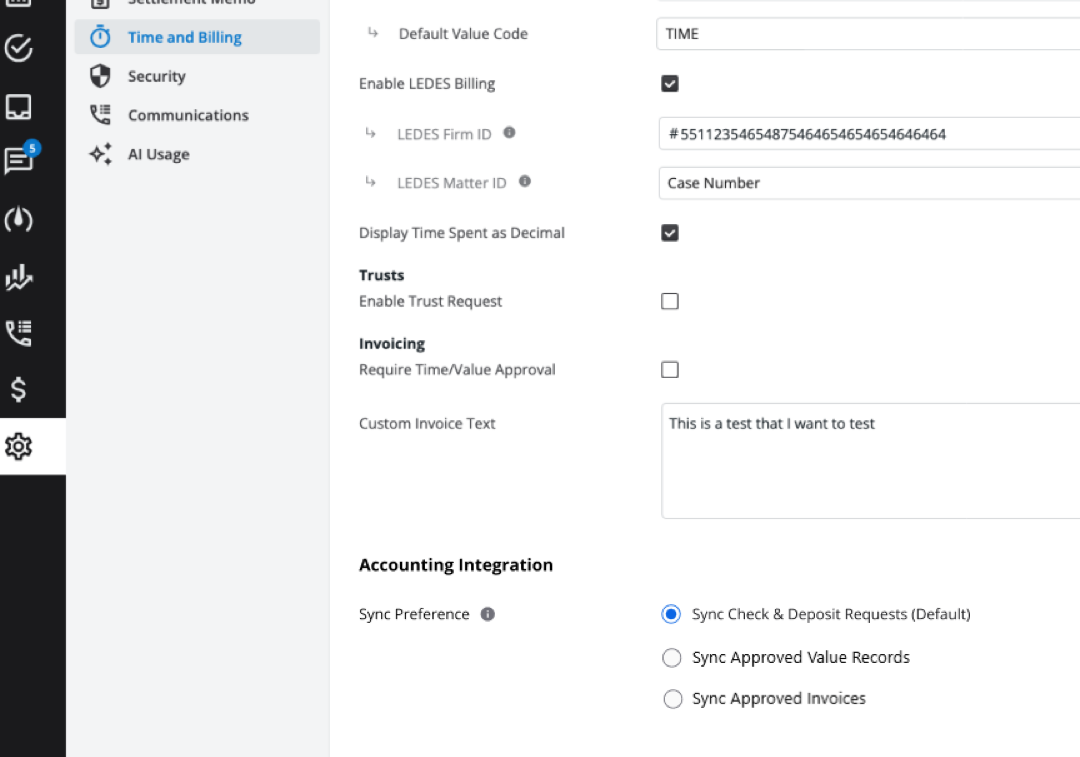
  • Users can enable the firm preference to sync approved value entries to QBO.
    • When this option is selected, time and value approval will automatically be turned on to support the synchronization process.
New_Firm_Preference_Sync_Approved_Value_Records_with_QBO.png


QuickBooks Online Integration - Syncing Approved Cost/Fee Value Entries to QBO 

It is an enhancement to the QuickBooks Online (QBO) integration that automatically syncs approved cost and fee value entries from Neos to QBO based on the firm’s sync preferences.
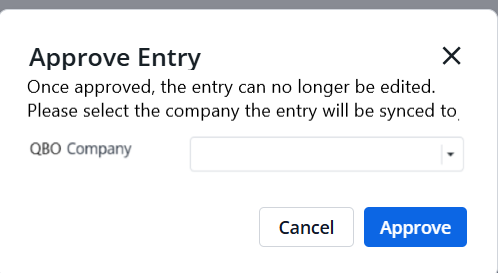
  • Streamlines the financial reconciliation process by automatically syncing approved costs and fees from Neos to QuickBooks Online.
  • Minimizes manual data entry and ensures that approved value entries reflect in QBO with accurate and up-to-date payment details.
  • Applies when the firm’s QBO integration is active and the “Sync Approved Value Entries” option is selected as the sync preference:
    • Any cost-type value entry approved in Neos will sync to QBO as an expense.
    • Any fee-type value entry approved in Neos will sync to QBO as a bill.
      • Once the cost or fee value entry is approved and synced, a payment transaction is automatically added for the full amount so the due amount equals $0.
        • The company is assigned at the time of approval.
Syncing_Approved_Entries_to_QBO.png


Improvements and Updates
Notes Paging 

Users can now continue paging through all notes using the arrow buttons, even after reaching the 50th note in the list.

Customer Requests #1936, 3124

Refresh Reminder after Releases 

After each major or maintenance release, users who haven’t automatically received the latest UI version will see a reminder every 10 minutes prompting them to refresh. Refreshing ensures you’re always using the most up-to-date version of Neos and helps quickly resolve any cache-related issues that can occur after a release. You’ll have the option to finish your work before refreshing so your progress isn’t interrupted.
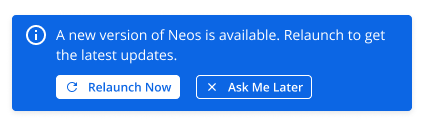
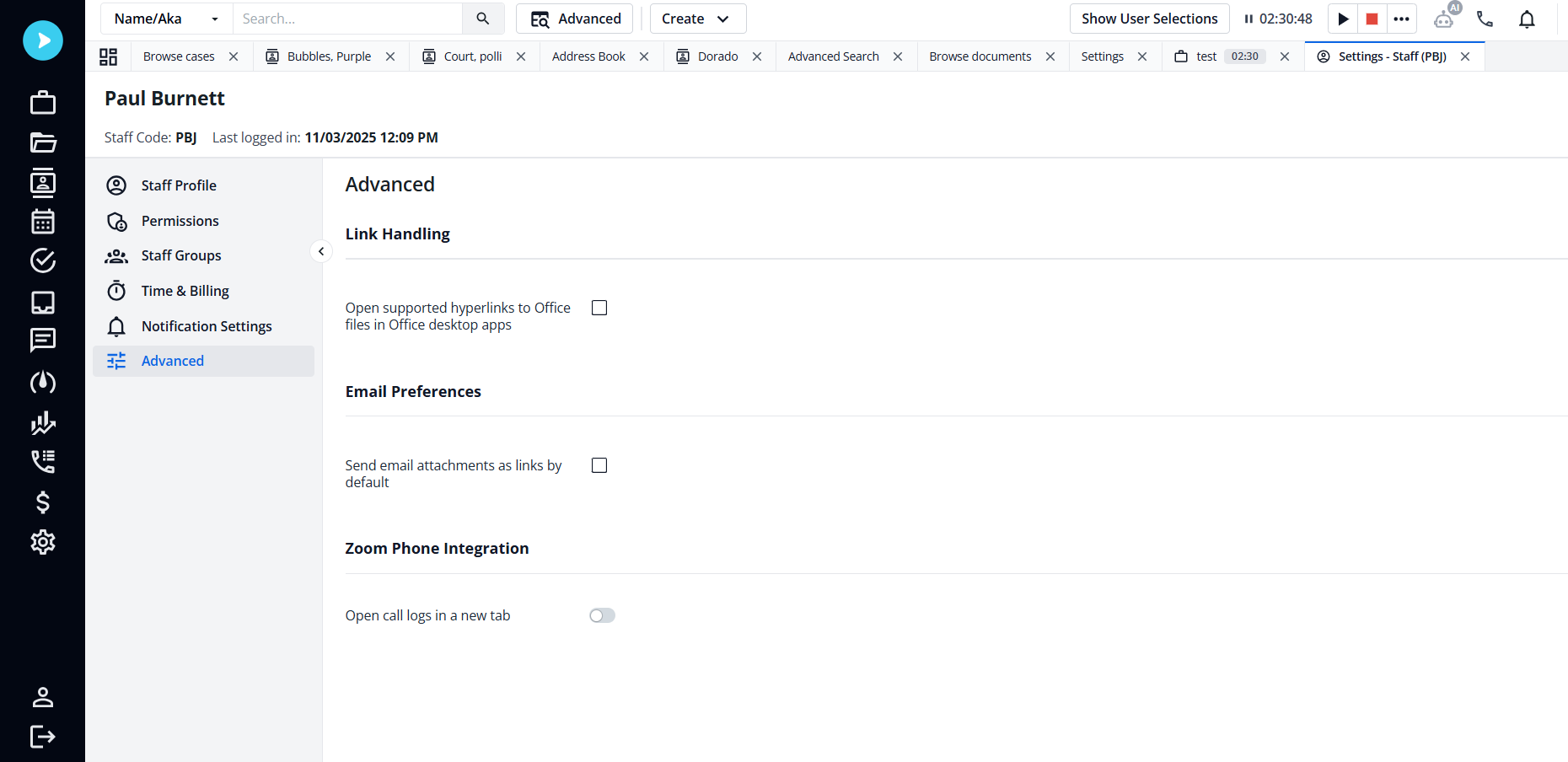
image-20251104-032042.png


Staff Profile - Default Email Attachment Type 
  • A new "Email Preferences" section has been added under the Advanced tab in Staff Profile.
    • This section includes a new checkbox option: "Send email attachments as links by default."
      • When Enabled:
        • All Send Email modals (Doc Details caret, Notes, Notes Grid, Case Actions) will default to the “Link” format for attachments.
        • Users can still manually select between “Link,” “Original,” and “PDF” formats when sending emails.
      • When Disabled:
        • Email attachments will continue to follow existing behavior with no default format changes.
image-20251104-020629.png

Customer Request #2745

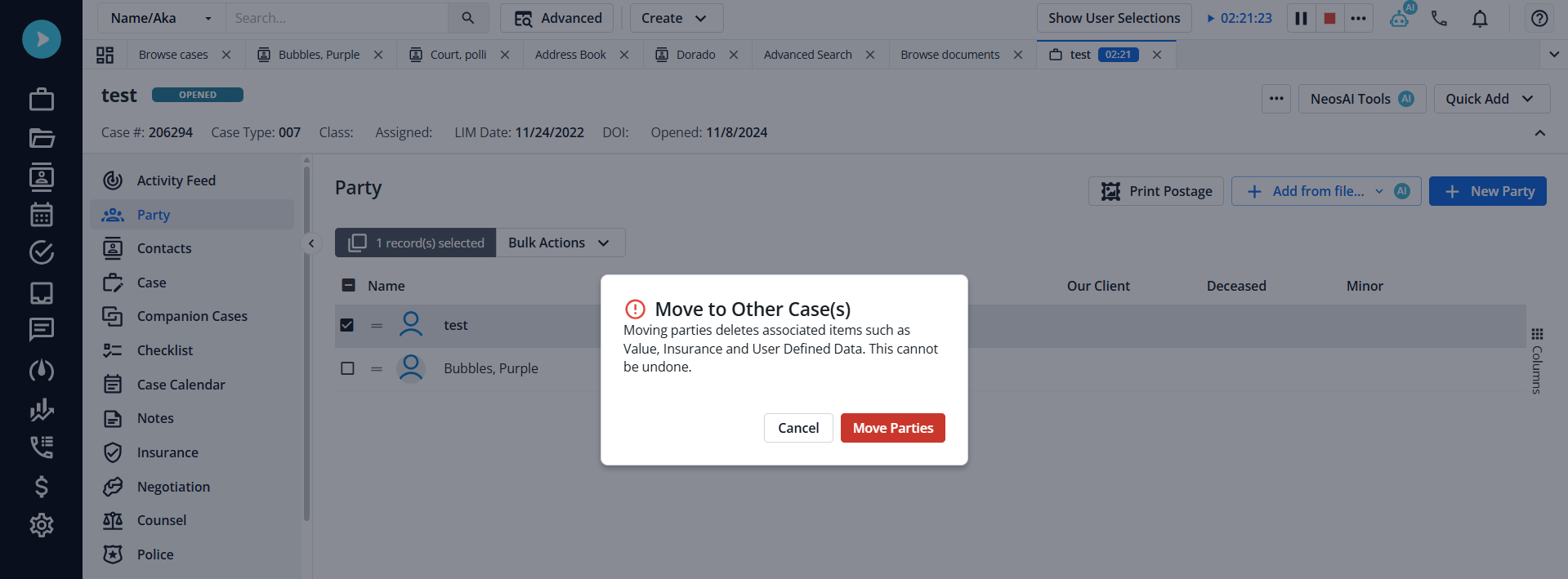
Added Warning Modal for Bulk Action: Move to Other Case(s) 
  • When a user selects target cases and confirms the move from the Party tab, a warning modal now appears with the following details:
    • Title: Move to Other Case(s)
    • Body: Moving parties will delete associated items such as Value, Insurance, and User Defined Data. This action cannot be undone.
    • Options:
      • Cancel – aborts the action
      • Move Parties – moves the selected parties and deletes associated data
image-20251104-002608.png


Register for the New in Neos webinar on November 14 at 1pm ET!

Hosted by the ebullient Bryan Billig, VP of Customer Education

Bryan will demo all the amazing new features being released this month in real time, cracking jokes along the way.

SHARE

Related to this article

new in neos feb

Legal Tech

Check out all the innovative new features and enhancements coming out with March's brand new release!

new in neos feb

Legal Tech

Check out all the innovative new features and enhancements coming out with February's brand new release!

Working on laptop

Check out all the innovative new features and enhancements coming out with November's brand new release!

Schedule a Neos demo

Manage your daily operations in less time, so you can spend more time focusing on your clients. See how it's possible.